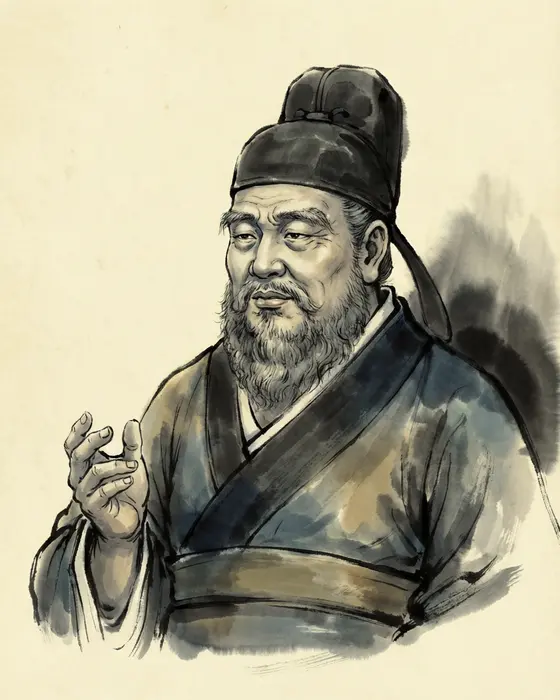
A former chancellor's rival and the one man the emperor had not let Chao Cuo destroy. He proposed the execution that was meant to end the war, carried the pardon to Wu, and was refused audience.
Wu and Chu's anger is at Cuo: execute him, give back the lands that were cut, and the seven kingdoms can withdraw their armies without bloodshed.Yuan Ang to Emperor Jing in a cleared council, 154 BCE; Shiji, juan 101, Memoir of Yuan Ang and Chao Cuo (the same scene in juan 106; Hanshu, juan 49)
Appears in
Relations
- Chao Cuo rivals — Cuo's answer to his criticism was the charge that survived in the record: Ang had taken a great deal of the king of Wu's money and had been covering for him all along.
- Emperor Jing commander — He asked for the room to be cleared before he would speak, and the emperor heard the proposal that sent a minister to the block and approved it.
- Liu Wu enemies — He argued the emperor's brother out of the succession, and the king of Liang had him knifed outside the gate wall at Anling.
Myth vs record
He killed Chao Cuo out of private hatred — two ministers who loathed each other, and one of them used a rebellion to settle the account.
The hatred is in the record: the two would not look directly at each other, and Cuo's side of it survives as an accusation he made to a subordinate, that Ang had taken much Wu gold and sheltered the king's plans, for which Ang was reduced to commoner rank and then taken back into use (Shiji, juan 101; Hanshu, juan 49). What the book makes of the proposal itself is policy, not pique: it was the rebels' own slogan turned round and offered as a settlement, and Ang had to carry it — he went to Wu, was refused audience, and got out only because a clerk he had once found in bed with his maid had pardoned him, given him the girl and re-employed him now as a guard officer: that man bought two jars of strong wine, got the corner guard drunk, cut the tent and walked Ang out between the sleepers in wooden clogs (juan 101). He died in 148 BCE at another prince's order, over the succession rather than the fiefs (juan 101).