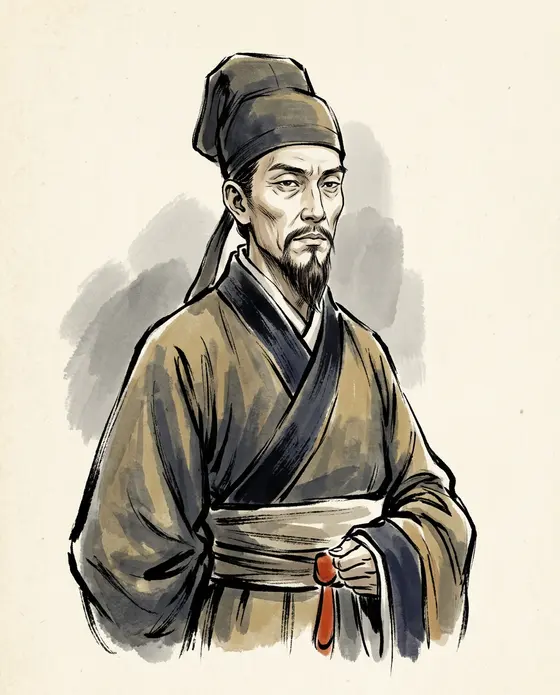
Imperial adviser turned Censor-in-chief, called the bag of wit of the eastern palace while he served the crown prince. He wrote the plan to cut the fiefs back and was delivered to the block in his court robes to buy the rebels' withdrawal.
Cut him and he rises at once, and the wound is small. Do not cut him and he rises later, and the harm is greater.Chao Cuo's argument on Wu to the new emperor; Shiji, juan 106, Memoir of the King of Wu (Hanshu, juan 49, Memoir of Yuan Ang and Chao Cuo)
Appears in
Relations
- Emperor Jing commander — He had been the crown prince's household officer, so persuasive that the eastern palace called him the bag of wit, and as Censor-in-chief he wrote the plan the emperor then signed.
- Yuan Ang rivals — They would not look straight at each other in court, and it was Ang who proposed his head in a room cleared for the purpose, with Cuo still standing outside the partition.
Myth vs record
A cold Legalist technician who picked a war he need not have picked, and the histories record him as a man who got what his own scheming deserved.
The execution is as flat as it is famous: the Commandant of the Capital sent for the Censor-in-chief with a carriage on the pretext of a meeting, the chancellor and the Commandant of Justice filed an indictment charging him with urging the emperor to lead out in person while he kept the capital and with offering Wu towns it had not even taken — sentence, waist-cutting, and his household killed in the market — and the emperor's reply is one word, approved (Shiji, juan 101; Hanshu, juan 49). His own father saw the price before anyone: he came on from Yingchuan to ask why, said the house of Liu was safe but the house of Chao was in danger, and poisoned himself a little over ten days before the seven kingdoms rose. The record does not call the plan wrong. An officer home from the front told the emperor that Cuo's scheme was the ten-thousand-generation benefit of the capital's supremacy, that its author had been destroyed while it was only just beginning to be carried out, and that inside, the loyal had been silenced and outside, the lords avenged; the emperor answered that his words were right and that he regretted it too (juan 101).