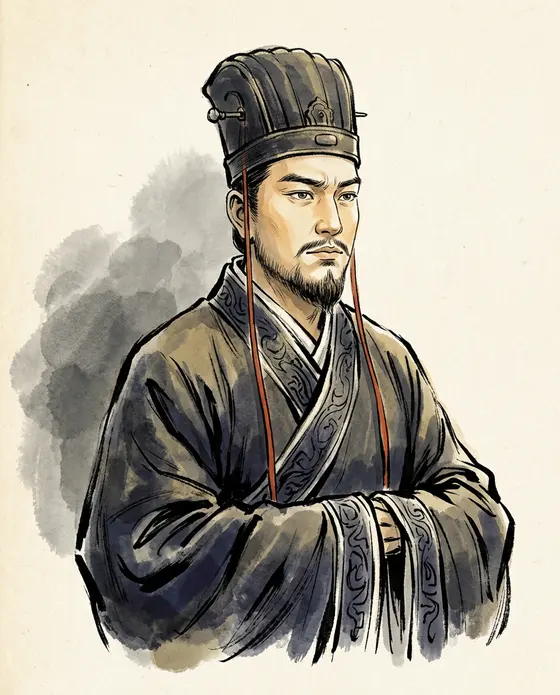
Liu Qi, second emperor of Han, the prince who had killed the heir of Wu with a gaming board. He approved the strategy that won, gave way to the one that did not, and said afterwards that he regretted it.
Let me see how far this can go. I am not so attached to one man that I will refuse the realm an apology.Emperor Jing's answer to Yuan Ang, after a long silence, 154 BCE; Shiji, juan 101, Memoir of Yuan Ang and Chao Cuo (Hanshu, juan 49)
Appears in
Relations
- Liu Wu brother — His full brother, whose capital he would not send relief to while the siege went on, and who spent the following decade working to destroy the commander that had let it happen.
- Liu Pi rivals — The king of Wu had not attended court for a generation, and the quarrel between their houses began with a gaming board thrown by an imperial crown prince.
Myth vs record
The mild second half of a golden age: a gentle, cautious emperor who inherited a settled realm, and whose one ugly act — hauling a minister out in his court robes to the East Market — was forced on him by men stronger than himself.
The mildness is in the record and the historians measure it in stores: the Shiji's treatise on the balanced standard, which Sima Guang copies into his closing survey of the reign, has cash piled in the capital's treasury with the strings rotting, and the old grain of the Great Granary overflowing outside and going bad (Shiji, juan 30; Zizhi Tongjian, scroll 16). But this is the man who, as crown prince, picked up a gaming board and killed the heir of Wu with it (juan 106); who approved Chao Cuo's cutting plan, and answered the demand for Cuo's head with one word; and who was told to his face by an officer home from the front that the killing had closed the loyal men's mouths inside and avenged the lords outside, and replied that the man's words were right and that he regretted it too (juan 101). What he did not do was turn: he let the war run on the plan he had signed, refused to move Zhou Yafu off his ramparts while his own brother's city was beaten to pieces, and after the surrender redrew the map, kingdom exchanged for commandery and prince moved from one fief to another (Hanshu, juan 5).