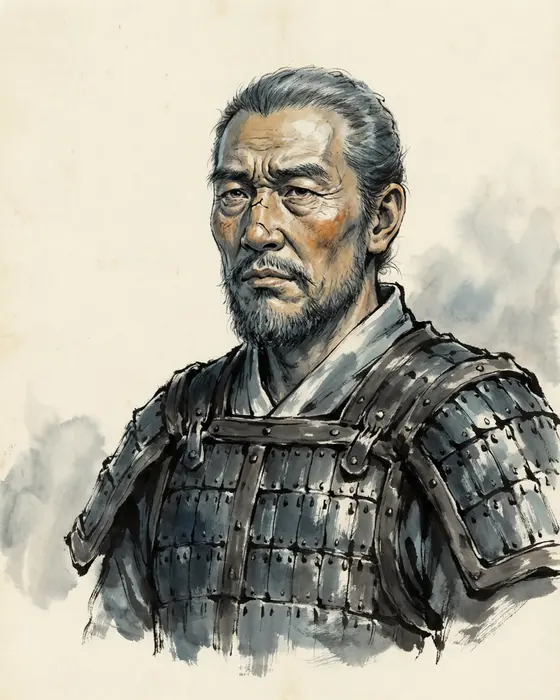
The one commander who argued against every frontier at once, and against encircling Kunyang. He got the king's head he said he would not hunt, and lost his rank for putting the bandits first.
Is this the fine-bearded one? How has he come to do a thing like this!Hou Han shu, juan 1 upper — his word on seeing Liu Xiu at Kunyang in 23 CE; the annal itself puts the admiration in his mouth
Appears in
Relations
- Wang Yi commander — He served in the last and largest host the New could raise, and he gave its commander-in-chief the same advice twice — hurry on the pretender's capital and let the cities fall by themselves, then leave one side of the ring open so the besieged could run. Both were refused.
- Wang Mang patron — He argued against every frontier at once while the throne was spending armies on all of them, took the king's head he had said he would not hunt, and lost his rank for putting the bandits of the interior first.
- Emperor Guangwu enemies — He was on the wall-side of the battle that ended the dynasty, and the man he admired across the field was the junior officer whose thirteen horse went out at night and came back with three thousand.
Myth vs record
The New dynasty's collapse was a war of geniuses: a brilliant general betrayed by a stupid commander-in-chief at Kunyang.
Yan You is real, and so is the advice he gave; what the record does not do is make him a hero of the defeat. His own career is a series of things he was punished for being right about, and at Kunyang he was a subordinate whose commander refused him twice and then lost the field because the mass was ordered to stay in its camps and could not help itself. The book's reason for the breaking is not genius but weather, order and arithmetic — the rain that fell like water poured, the wind, and a ring of tens of layers that could not move — and the two histories disagree about the numbers while agreeing about the storm.