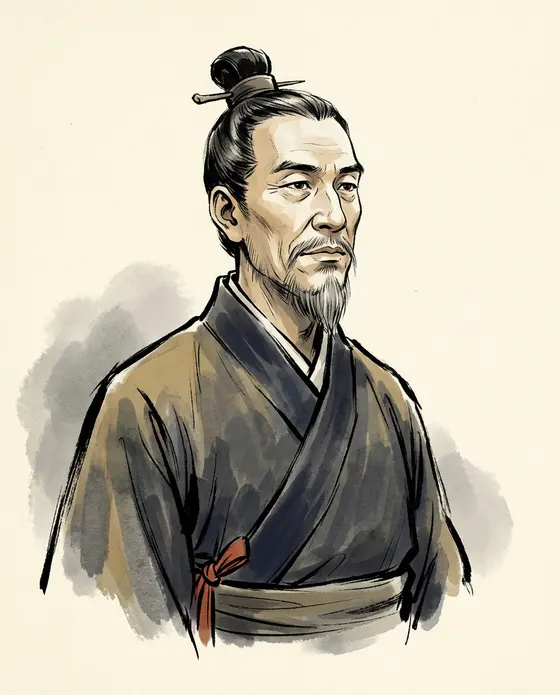
Liu Xiu of Nanyang, a distant grandson of the first Han emperor who took the throne in 25 CE at thirty-one and died in 57 CE at sixty-two. He spent the thirty-two years between on taking the empire's size down.
When I set the empire in order, I too mean to go about it by the soft way.His answer to the aunts of his own village in the spring of 41 CE; the phrase ruo dao is his own — Hou Han shu, juan 1 lower
Appears in
Relations
- Liu Yan brother — His elder brother Bo Sheng raised the rising; the emperor they had served had him killed within three months, and Liu Xiu rode straight to the capital to apologize for it, never boasting of Kunyang, never mourning, eating and drinking and talking as always. In 39 CE he named the brothers after death.
- Lady Yin Lihua wife — The beauty of Nanyang he admitted wanting as a poor young man; he made her empress in the spring of 41 CE, in the same season as the village visit and the shrine for four generations of the Chongling line.
- Deng Yu colleagues — The boy who attached himself to him in the capital's college and rode north to tell him an empire was there for the taking; he consulted Deng Yu about every general he employed, and the picks all fitted the post.
Myth vs record
Guangwu took Kunyang with ten thousand and smashed a million by a genius's surprise attack, with heaven visibly on his side.
The odds are the historians' own and they do not match. The Book of the Han calls the mobilisation a million and reports four hundred and twenty thousand mustered at Luoyang; the Book of the Later Han keeps both, gives eight or nine thousand in the city, a thousand and odd in the relieving column and three thousand at the water — and then adds the meteorite in the camp, the cloud that fell and scattered a foot above the ground, and the tens of thousands driven into the Zhui river until the water would not run. No early text has ten thousand against a million, and the romances of the restoration, which supply the chivalric pursuit and flight everybody remembers, are Ming and Qing books and not evidence. What the records credit is a strike on a stationary ring in the rain.