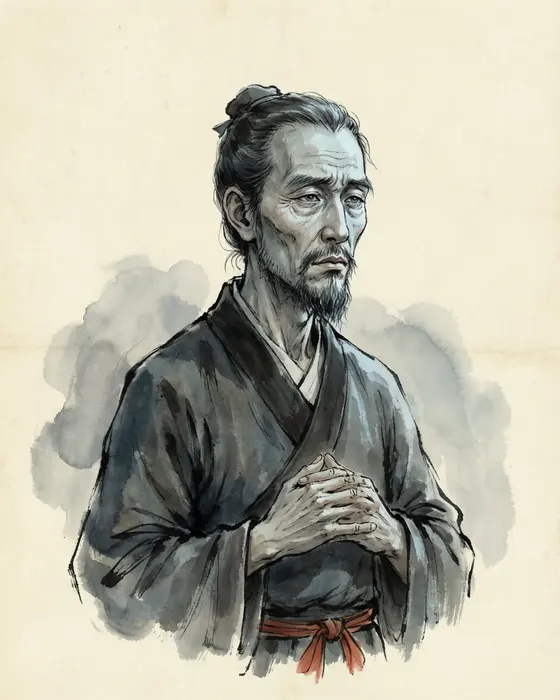
Regent, then the one emperor of the New. Poor in a house of nine marquisates, famous for his own frugality, he governed an empire the way he had read a classic: by correcting the words.
Heaven produced the virtue that is in me. What can the troops of Han do to me? — said on the terrace in the palace lake in the tenth month of 23 CE, with the mandate documents and the bronze Dipper in his arms.His own last recorded line; the book says he took it out of the Analects — Hanshu, juan 99 lower, Biography of Wang Mang
Appears in
Relations
- Grand Empress Dowager Wang rivals — She was the only refusal he could not buy or argue with. To take the throne he needed the Han's transmission seal, and she held it; she threw it on the floor at his messenger's feet and told his brothers they would be clan-exterminated — and he then gave a banquet in her honour on the terrace in the middle of the lake.
- Emperor Guangwu enemies — The man who replaced him was a distant grandson of the dynasty he had displaced, and had been one of the junior officers in the army he sent against the rising. He was killed at the end of the same year that the future emperor's brother was murdered by the emperor the Liu family had made.
- Liu Xin colleagues — He wrote his institutions out of the ritual classics and found the age's greatest scholar of texts to do the writing with him; the book's summary of the mandate literature that came out of that partnership is that its wording was elegant and borrowed from the classics, and all of it manufactured argument.
Myth vs record
Wang Mang was a Chinese socialist a thousand years early: state land, state monopolies, price control and planned credit.
This is a twentieth-century reading — Hu Shi made it explicitly in the 1930s — and the laws name their own model, which is not a ministry of planning but the Rites of Zhou: the well-field of Yu, the Zhou officer who bought up unsold goods, the five levels of price in the Yueyu, the loan against interest for funerals and sacrifices. Ban Gu's character note is decisive: he could not start a single thing without first finding a line of scripture to authorise it. Nor was it egalitarian: the land law confiscated nothing from a household of eight or fewer male mouths, which makes it nearer a ban on the traffic than a redistribution, and its author withdrew it in the fourth year after one officer's memorial.