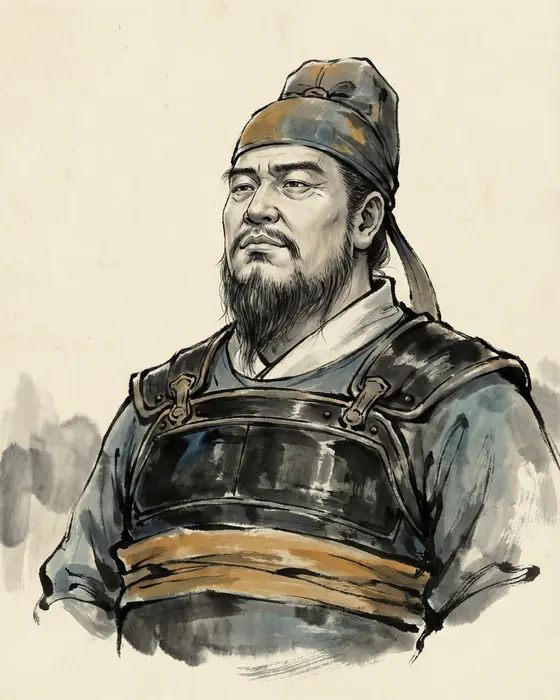
Emperor Gaozu of Han, founder. Took the field in the tenth month against a vassal's revolt, reached Pingcheng before his own army, and spent seven days inside a closed ring of cavalry. On the way home he apologised to a man he had put in irons and told the army he had killed the ten who had advised the march.
A law of three articles: whoever kills a man dies; whoever wounds a man, or robs him, answers for it in his person. All the rest of the Qin law is void.Liu Bang to the elders and worthies of the Guanzhong counties summoned at Bashang, 206 BCE; Shiji, juan 8, Basic Annals of Emperor Gaozu (Ban Gu copies it with small changes into Hanshu, juan 1, Annals of Emperor Gaozu)
Appears in
Relations
- Xiang Yu rivals — Sworn together under the King of Chu to break Qin, and parted by the promise that whoever entered Xianyang first should rule it.
- Fan Kuai brother — A dog butcher of Pei who married the sister of Liu Bang's wife and came in with a shield through the gate at Hong Gate to keep his brother-in-law alive.
- Xiao He colleagues — Fellow men of Pei out of the same county office, where Xiao He more than once shielded the village head from the law while both were ordinary men.
Myth vs record
The founder was a swaggering village ruffian who won by noise and luck, a tyrant whose hair stood up when he was crossed.
The hair that bristled at Hong Gate is Fan Kuai's, and the annals say so (Shiji, juan 7). What the record keeps about this man is that he reversed himself in front of his own officers: he walked back out of the Qin palace when he was told to, handed the surrendered King of Qin over unharmed, and at Guangwu took Liu Jing's chains off before the army and said out loud that he had not taken his advice (juan 8; juan 99). His own answer for how he took the empire names three men he outranked — planning inside the tent, holding the country and feeding the army, leading a hundred thousand in the field — and says he was not the equal of any of them (juan 8). He was fifty when he came down the pass road.