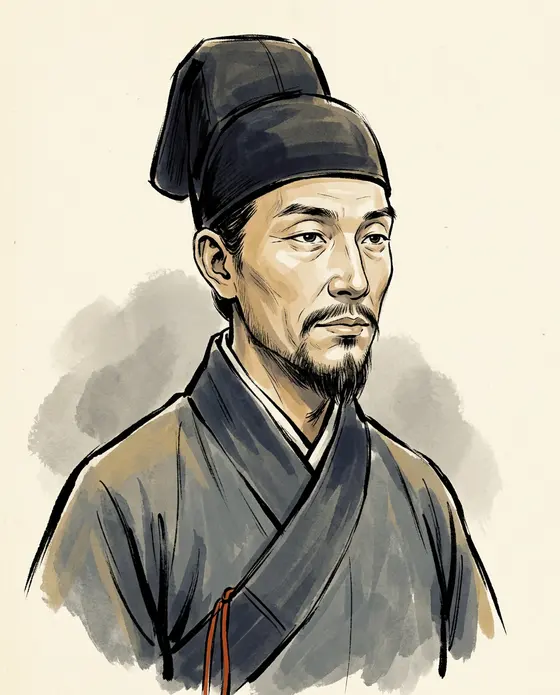
Liu Bang's old superior in the county office. While the generals scrambled for gold he loaded the archives: maps, registers, statutes.
The King of Han came to know the empire's throats and sores, the numbers of its households, its strong places and its weak, and what the people suffered — all because Xiao He had taken the Qin documents whole.Sima Qian's judgment on what the archives were worth; Shiji, juan 53, Hereditary House of Chancellor Xiao (the same career in Hanshu, juan 40)
Appears in
Relations
- Liu Bang colleagues — He had been chief clerk of Pei and had shielded Liu Bang from the law more than once while both were ordinary men, and later drew up the statutes the dynasty ran on.
- Fan Kuai colleagues — Old men of the same county office; when the gates opened and the generals ran for gold, these two took the two things nobody else wanted — the shield and the archives.
Myth vs record
Xiao He made Han Xin and Xiao He undid him: the patron who chased the great general through the night under a moonlit sky, then wrote to tell him to come and congratulate the court — and the palace guards killed him in a bell chamber.
The chase and the bell chamber belong to a different Han Xin, the Marquis of Huaiyin, whose memoir is Shiji, juan 92; the idiom about making and unmaking is a later proverb hung on that chapter, not a fact this line has reached. The King of Han who handed Mayi to the steppe in 200 BCE is a namesake and a different man entirely (juan 93). What Xiao He's own chapter puts first is quieter and better documented: while every general was filling carts with gold and silk he went to the offices of the chancellor and the censors and had the law codes, the household registers and the maps put away, and Sima Qian says in so many words that this is how the King of Han knew the empire's throat and its sores after Xiang Yu burned the capital (juan 53).