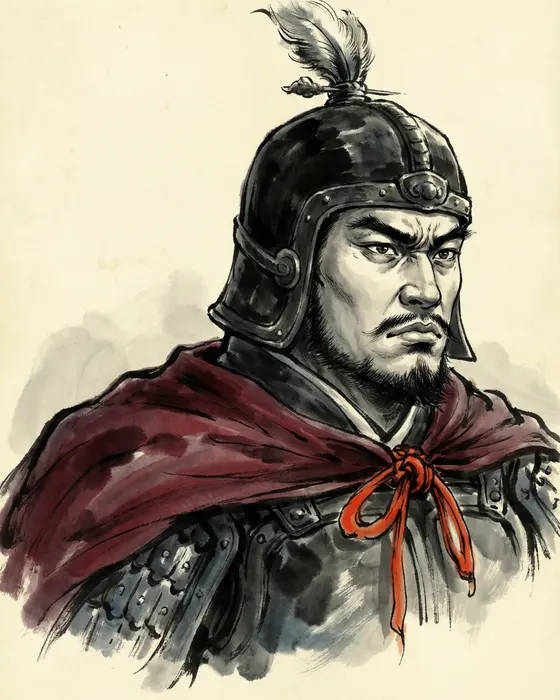
Commander of the allied armies, forty thousand strong. Broken the Qin main body already, he came west to punish a man he had agreed to make king.
He boasted of his achievements and ran on private cleverness without taking the ancients as his model, and in five years he lost his state. Still he did not wake up or blame himself. To say 'Heaven destroys me, not my fighting' — how mistaken!Sima Qian's judgment closing the annal; Shiji, juan 7, Basic Annals of Xiang Yu
Appears in
Relations
- Liu Bang rivals — He had agreed to make the man who entered Xianyang first a king, came west with four hundred thousand to punish him, drank at Hong Gate and let him go.
- Fan Zeng patron — The old man of Juchao he raised to the place of Second Father, whose three lifted jade ring-slices he looked at and did not answer.
- Ziying enemies — Liu Bang handed the surrendered King of Qin over to the palace officials unharmed; when Xiang Yu's army entered the capital it put him to death.
Myth vs record
He lost the empire at Hong Gate because he was too honourable to kill a rival when he had him at a banquet.
The histories give a smaller reason and a larger one. Smaller: he had taken Liu Bang's submission in front of his own officers, and Fan Zeng's signal was looked at and not answered (Shiji, juan 7). Larger: what he built three months later — eighteen kingdoms, himself styled overlord of Western Chu, Liu Bang parked behind three Qin kings in the valley of the Han — is the settlement that had to be lost, and Sima Qian sets it out in full before he lets the banquet carry any weight. The sentence he died saying, that Heaven was destroying him and fighting had done nothing wrong, is in the same chapter; the quote on this card is the Grand Historian's answer to it.