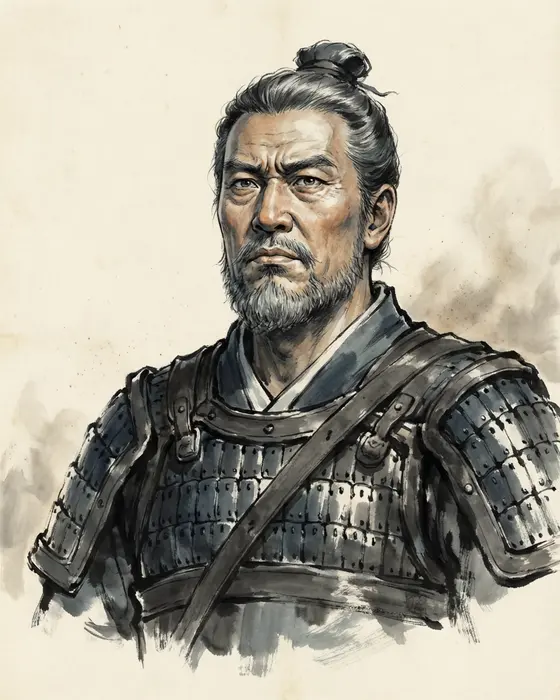
Right Commandant of the Guards, fighting his own war at Wan. The one officer who argues that men with no way out must fight to the death — and who refused a surrender for that reason, took the place by storm, and is credited with the killing either way.
A city whose help is outside holds to the last man when you press it. We are forcing men with no way out to be brave. Open the ring and fall on them as they come.Zhu Jun to his staff at Wan, 184 CE; Hou Han shu, Memoir of Zhu Jun, juan 66 — advice given to his officers, compressed into the form quoted
Appears in
Relations
- Huangfu Song colleagues — The second of the two central-intelligence generals of 184, fighting his own war at Wan while Song's fire went up in Yingchuan.
- Lu Zhi colleagues — Three commanders sent out of the northern army's campuses in one spring, and all three struck afterward by the court they rescued.
- Zhang Rang enemies — He was dismissed over his own report of the war, which is how the inner court answered the man who had taken Wan.
Myth vs record
The heroes of the novel's opening — the sworn brothers of the peach garden — made their names crushing the Yellow Turbans.
The record of that war has almost no room for them. It was fought and won by the dynasty's own career officers: Lu Zhi north against Julu, Huangfu Song and Zhu Jun west into Yingchuan, Dong Zhuo east, and a defeated Dong Zhuo who had to be lifted out by Lu Zhi's soldiers. Zhu Jun's own memoir states his price in the plainest way, as a credit: tens of thousands beheaded after Wan fell. The oath and the brothers' first battles belong to the fourteenth-century Romance, not to the histories — and the empire paid its real saviours with chains, dismissal and an invented charge.