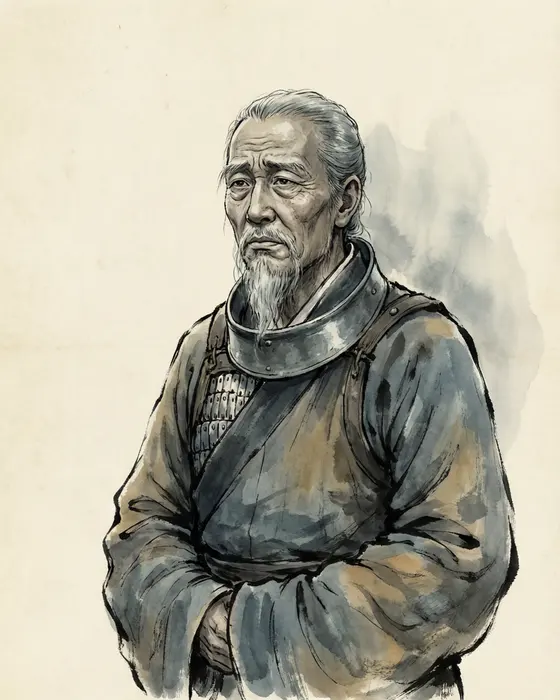
North Commandant of the Guards, leading the northern army's five campuses, and the age's great teacher of the classics. He would not fee the Yellow Gate envoy sent to his camp, was reported for it by the man himself, and lost his command and very nearly his life.
If I am a criminal, how dare I not pay the salute? But when the order comes with its settled wording, I will take it then.Lu Zhi's answer to the eunuch who came to his camp and was given nothing, 184 CE; Hou Han shu, Memoir of Lu Zhi — his words, compressed
Appears in
Relations
- Huangfu Song allies — He testified for the general the inner court was prosecuting, and when the arrest came for him it was that general's road he was taken down.
- Zhu Jun colleagues — North, right and left central-intelligence generals in the one emergency, and three men the court afterwards made examples of.
- Liu Bei patron — The Three Kingdoms history says a kinsman's son of Zhuo, then of no name, sat in his classes in the north — he taught the man who outlasted the dynasty he saved.
Myth vs record
A minor name in the novel's first chapter, a scholar who happened to be general.
He was the age's great teacher of the classics and the commander who very nearly finished the war by himself: works thrown round Guangzong, Zhang Jue fast inside them all summer. That was going well enough to be complained of — a eunuch came to inspect the camp, was paid nothing, reported the town unwon, and the court took his command away and sent a mounted file to fetch him out in chains. He was condemned and escaped only by hiding. Note also that the memoir names the eunuch at his camp as a man of the surname Zhao, not Zhang Rang; Zhang Rang stands here for the ring that held the throne, not for the visitor.