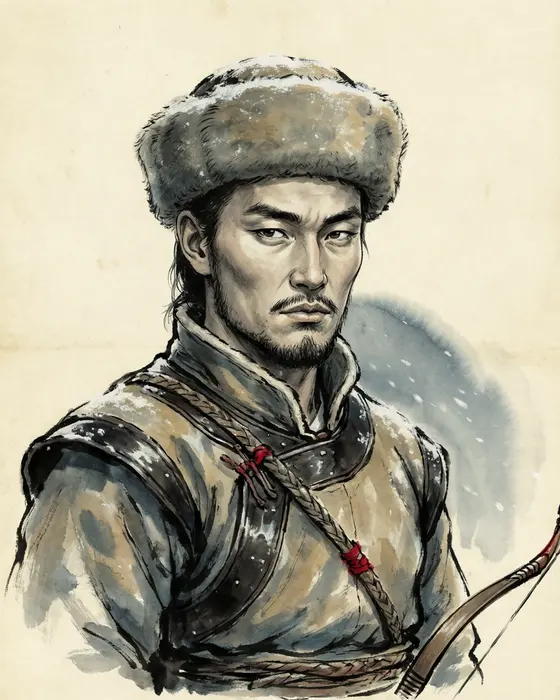
Chanyu of the Xiongnu. He drilled his escort with a whistling arrow, killed his father with it, took a horse, a wife and a thousand li of empty grazing from the Eastern Hu, then hid his fat cattle and strong riders to lure the Han north.
What they asked for is waste grass — but a state stands on its land. How can it be given away!Modu to his councillors on the Eastern Hu's third demand, before he rode out and destroyed them; Shiji, juan 110, Annals of the Xiongnu (Hanshu, juan 94a)
Appears in
Relations
- Liu Bang enemies — He hid his fat cattle and his picked riders behind old men and lean animals to lure the emperor forward, then closed a ring of cavalry sorted by coat colour round Baideng for seven days and let one corner open.
- Han Xin allies — The frontier king of Han handed him Mayi and then led Xiongnu cavalry against his own empire for five years, which is how the Chanyu knew where the Han army was.
- Liu Jing enemies — The one man in the Han court who said out loud that he could not be attacked, and the one who afterwards wrote the bride, the yearly cargo and the sworn brotherhood that answered him.
Myth vs record
A nomad raider who happened to be strong: the steppe comes and goes, it has no policy, and only a wall is an answer to it.
The record makes him a state-builder who ran deliberate deception as doctrine. He drilled his escort to shoot whatever his whistling arrow struck, on pain of death, tested the drill on his own best horse and his own favourite wife, then put the arrow into his father in 209 BCE, and afterwards killed his stepmother, his brother and every official who would not take the order (Shiji, juan 110). He let the Eastern Hu ask him for a thousand-li horse, then for a wife, then for a strip of grazing nobody lived on, gave the first two, and executed every councillor who said the grass could be spared. At Pingcheng he showed the Han envoys only the old and the starving on purpose; at Baideng he loosed picked cavalry into a ring and then opened one corner of it on his wife's argument and a rendezvous his defectors failed to keep; the settlement that followed was drafted as an agreement between two courts sworn as brothers, and it held, with quarrels, until 133 BCE.