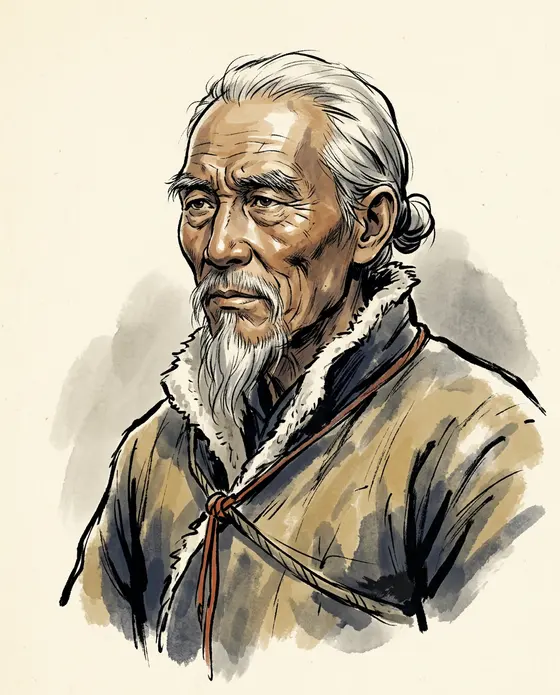
A conscript from Qi in a sheepskin coat who argued the court into camping the capital inside the pass, then reported that the Xiongnu could not be attacked and was chained for it. Released with a marquisate of two thousand households, he wrote the marriage-tribute agreement and proposed moving over a hundred thousand people into the Wei valley.
Two states at war display what they have. All I could see was the old and the lean. They are showing their short side on purpose to keep a strong arm in reserve — the Xiongnu cannot be struck.Liu Jing's report to the emperor before the northward march, 200 BCE; Shiji, juan 99, Memoir of Liu Jing and Shusun Tong (assembled in Zizhi Tongjian, scroll 11)
Appears in
Relations
- Liu Bang commander — A conscript in a sheepskin coat who argued the court into camping the capital inside the pass, was chained for saying the Xiongnu could not be attacked, and had the chains taken off in front of the army on the road home.
- Modu enemies — He read the bait — the old men, the starving cattle, the strong arm held back — and was put in irons at Guangwu for reporting it.
Myth vs record
Cutting the great fiefs back was Chao Cuo's invention in 154 BCE, and the sheepskin-coat man from Qi was a lucky prophet of the capital's site whom the emperor rewarded on the spot.
The policy is older by half a century and it is his. The Shiji names it in his own memorial — strengthen the trunk, weaken the branches: he asked for the Tian of Qi, the Zhao, Qu and Jing of Chu, the descendants of Yan, Zhao, Han and Wei and the region's famous strongmen moved inside the Wei valley, at nearest seven hundred li from the Ordos horse, so that at peace they faced the Hu and if the lords moved there would be enough of them to march east; the record counts over a hundred thousand people moved (Shiji, juan 99). Nor was he rewarded on the spot: the insult he is quoted with on the road north — slave of Qi, you got your office with your tongue — stands on the same page as the apology, and the ten parties of assessors were beheaded on the emperor's own statement (juan 99). His name at the head of that page is Lou Jing; the surname Liu, the style Fengchun Jun and the marquisate of Jianxin, two thousand households, were all given him by the man he had contradicted.