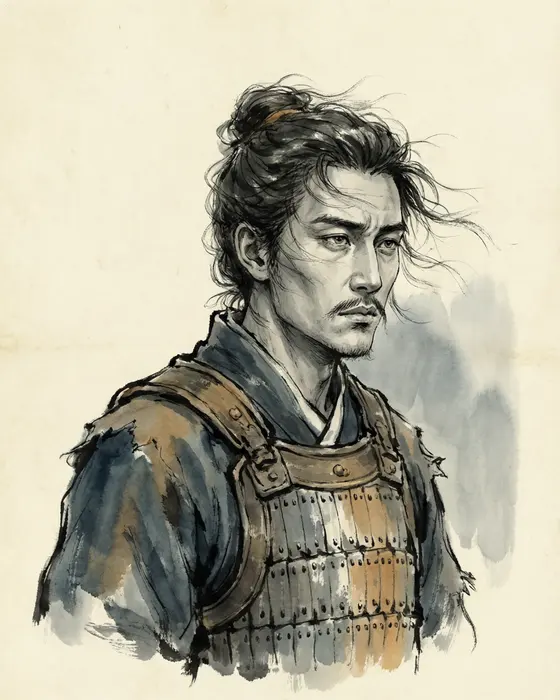
Grandson of the famous shot Li Guang and heir to his posthumous marquisate. Given five thousand foot and no horse: thirty days north, a month of retreat south, a surrender, then twenty-odd years as the Chanyu's son-in-law.
Another few dozen arrows and I could have got clear. Now we have no weapons left. Scatter, every man as birds and beasts scatter — some of you may still get free and tell the Son of Heaven.Li Ling's last order to his officers before the breaking of the army, 99 BCE; Hanshu, juan 54, Memoir of Li Guang and Su Jian; relayed in Zizhi Tongjian, scroll 21
Appears in
Relations
- Li Guang successor — Grandson of the old shot and posthumous heir of his house, he was thought by the emperor to have his grandfather's style, and died abroad like his father's line had not.
- Sima Qian allies — They had never drunk a cup together and were of no party; asked what he made of the defeat, he said what happened had happened, and the sentence fell on him instead.
Myth vs record
Li Ling went over to the enemy of his own will, became their general and drilled their horse against his own frontier, and his family's execution was deserved.
The memoir has him surrender after five hundred thousand arrows were spent, the banners cut down, the treasure buried, and the road at an end a hundred-odd li short of the wall, with four hundred and odd men of five thousand getting in; he told his officers to scatter so that someone might reach the passes and report. The emperor afterwards said the mission had been mismanaged — he had been wrong to write Lu Bode into the edict — and sent an envoy to reward the survivors. The report that produced the attainder came from a Han column that could not find him and lost its own men; the drilling, the histories say, was being done by Li Xu, another surrendered officer, and Ling had him assassinated for it. He was invited home after Emperor Wu's death and refused: he was already in Xiongnu dress, and the alternative he named was the hands of the clerks. He died among the Xiongnu in 74 BCE.