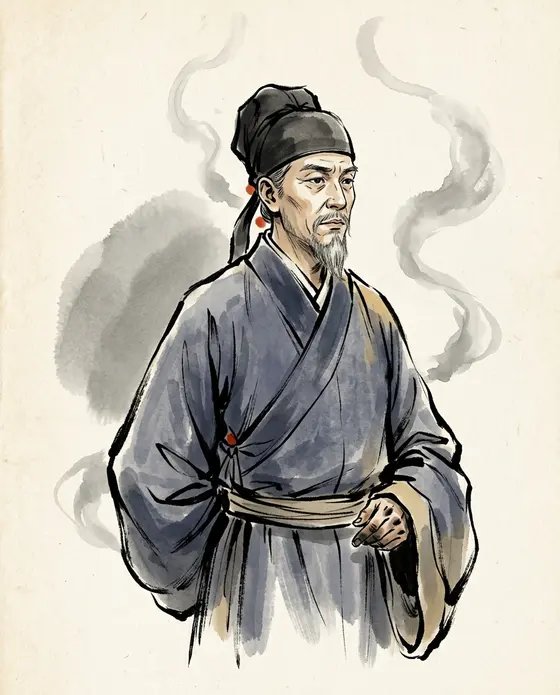
Grand Astrologer, keeper of the stone chamber and the golden cases. He had never drunk a cup with Li Ling; asked his opinion he gave it, and took the palace punishment rather than leave a hundred and thirty chapters unfinished.
A man must die once. Some deaths are weightier than Mount Tai, some lighter than a feather — it all lies in what they are for.Sima Qian, the letter of reply to Ren An; Hanshu, juan 62, Memoir of Sima Qian; the same document transmitted independently in Wenxuan, juan 41
Appears in
Relations
- Ren An colleagues — Ren An's reproach about the duty of recommending men is the occasion of the letter, and Sima Qian answers that he has no standing left to answer it.
- Li Ling allies — He had no debt to Li Ling and no party, and he said in front of the court that five thousand foot had been made to carry a whole campaign's failure.
- Emperor Wu enemies — The emperor judged the speech a slur on his wife's brother and a plea for the surrendered general, and he took the palace punishment rather than leave a hundred and thirty chapters unfinished.
Myth vs record
He was castrated and then put to death because the emperor read his history and was enraged by its candour.
Both books give one narrow cause, and it is a spoken sentence about Li Ling in the year after the surrender — he says himself that with his mouth's words he met this calamity — years before the book was finished. No official history has the emperor reading a page of it before punishing the man; the record says the opposite, that afterwards he was made Master of the Secretariat and honoured and entrusted with the documents that reached the throne. The stories of a ruler reading and killing the historian are later than the histories and reach us in anecdote. And no history used here says when or how Sima Qian died at all, which is the strangest silence in the chapter.