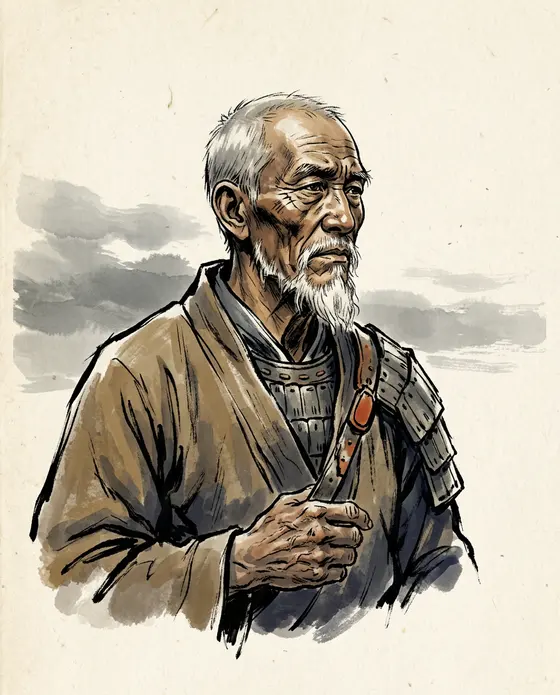
The old frontier shot, past sixty and with the luck against him, given the long road east instead of the Chanyu. He lost the way, and refused to be written up by a clerk.
Since I tied up my hair I have fought the Xiongnu in seventy-odd engagements. The General-in-Chief has put me on a circuitous road; I have lost the way — is it not heaven? I am past sixty and cannot answer a clerk with his brush.Li Guang to his own colonels before drawing his sword, 119 BCE; Shiji, juan 109, Biographies of General Li of Longxi; juan 111
Appears in
Relations
- Wei Qing commander — The General-in-Chief moved him onto the poor eastern road to make room for Gongsun Ao at the meeting with the Chanyu, and it was at his marquee that Li Guang was summoned to be written up.
- Emperor Wu commander — He had begged for this one battle at the Chanyu, and the emperor had given secret instruction beforehand that Li Guang was old and had the luck against him and must not be allowed to face him.
- Li Ling successor — His grandson inherited the house's name for the frontier and the same command that had to be proved in the steppe, and lost both in 99 BCE.
Myth vs record
The Flying General: whose name alone kept the Xiongnu horses from the passes, a wall of one man, unlucky and therefore heroic.
That is a Tang poem eight centuries away. The biography gives an excellent shot and a generous officer whom the frontier peoples liked, and a career that the audits keep: small columns, missed trysting days, capture by the enemy and escape, defeats bought off as a commoner by paying the fine, and never a marquisate for him though his kin and his men got them. In 119 BCE the emperor's secret order took the Chanyu out of his reach and Wei Qing wanted Gongsun Ao at that meeting; he lost the road, refused the clerk's board, and killed himself in front of his army. Sima Qian says the man himself was diffident as a countryman and unable to put a sentence together, and writes the death as humiliation, not as guilt.