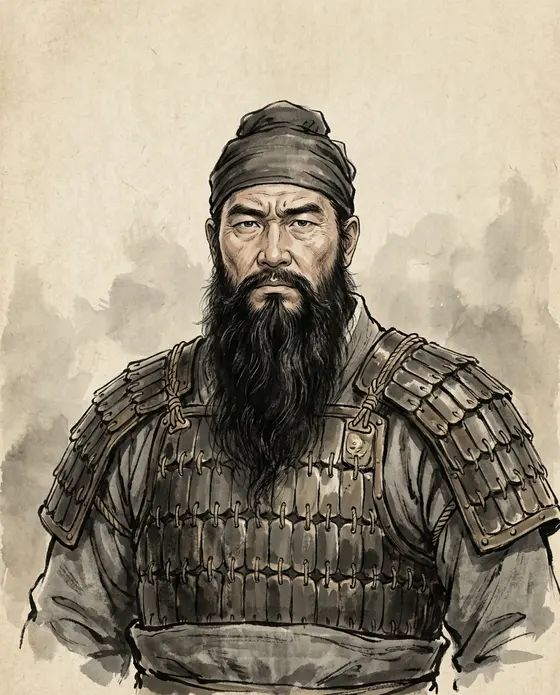
A general of Liu Bei from the first raising of troops. In 200, briefly in Cao Cao's camp, he ended Yan Liang at Boma — then went back.
Yu saw Liang's canopy and banner, spurred his horse into the midst of the ten thousand, beheaded Liang and returned; among the generals there was none who could stand against him.Sanguozhi, Shu shu 6, Biography of Guan Yu
Appears in
Three Kingdoms 2 · panel 5Three Kingdoms 3 · panel 2Three Kingdoms 8 · panel 1Three Kingdoms 8 · panel 2Three Kingdoms 8 · panel 3Three Kingdoms 8 · panel 4Three Kingdoms 8 · panel 5Three Kingdoms 8 · panel 6Three Kingdoms 8 · panel 7Three Kingdoms 8 · panel 8Three Kingdoms 8 · panel 9Three Kingdoms 8 · panel 10Three Kingdoms 8 · panel 11Three Kingdoms 8 · panel 12Three Kingdoms 8 · panel 14Three Kingdoms 8 · panel 15Three Kingdoms 8 · panel 16
Relations
- Liu Bei lord & brother in all but name — The histories say they slept in the same bed and shared as brothers; the oath in the peach garden is the novel's.
- Cao Cao brief master — Captured in 200, honoured, and gone within the year. His men wanted to pursue; Cao Cao said each serves his lord, and let him go.
Myth vs record
The story you may know
The red-faced god of war with the Green Dragon Crescent Blade, sworn in a peach garden, deified in every temple.
What the sources say
The sources give a bearded general — Zhuge Liang's letter calls him the beautiful-bearded — with a plain soldier's blade, no oath scene and no divinity; the deifications begin centuries later, under Song and Ming emperors. What the record gives him is the one sentence at Boma, which needed no legend.