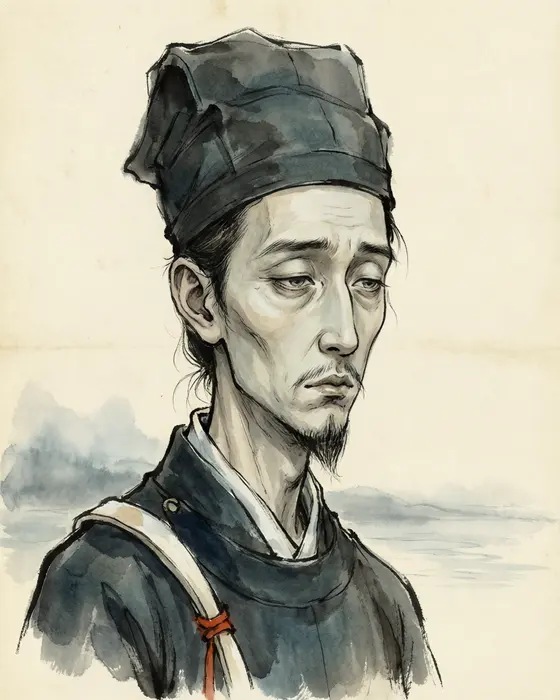
Heir of a destroyed state, counselor to both men in turn. Persuaded his general to sleep in the open and later walked him out of a banquet.
You have no sooner entered the pass than you want to rest in what the Qin rested in. That is what is called helping the tyrant oppress.Zhang Liang to Liu Bang in the Qin palaces at Xianyang, 206 BCE; Shiji, juan 55, Hereditary House of Marquis Liu
Appears in
Relations
- Liu Bang commander — He had been given orders to attend the Lord of Pei for the King of Han, and said that vanishing now, with the man he served in danger, would be unrighteous and unspeakable.
- Fan Kuai colleagues — At the worst moment of the banquet Zhang Liang went out at the gate of the camp and brought Fan Kuai in with his shield; the counselor and the chariot-partner saved the same lord from opposite ends.
Myth vs record
The idiom has him for ever: the man who decides a thousand li away inside the tent, a cold otherworldly strategist with no body and no wants.
The idiom is genuine — it is Liu Bang's own sentence, and Sima Qian quotes it back in the final judgment of the hereditary house (Shiji, juan 55). So is a good deal of the mystique: the same chapter says he learned grain-avoidance and breath-cultivation after the empire was settled and wanted to follow Red Pine, and that he shut his door and did not go out for over a year. What the chapter also records is a sickly man who asked for the smallest fief on offer — the place where he and Liu Bang had first met — and says in the text why he was asking for nothing. And Sima Qian adds that he had pictured someone towering and strange, and finding the portrait, found a face like a beautiful woman — the magician in the mountain cap is the novel's doing.