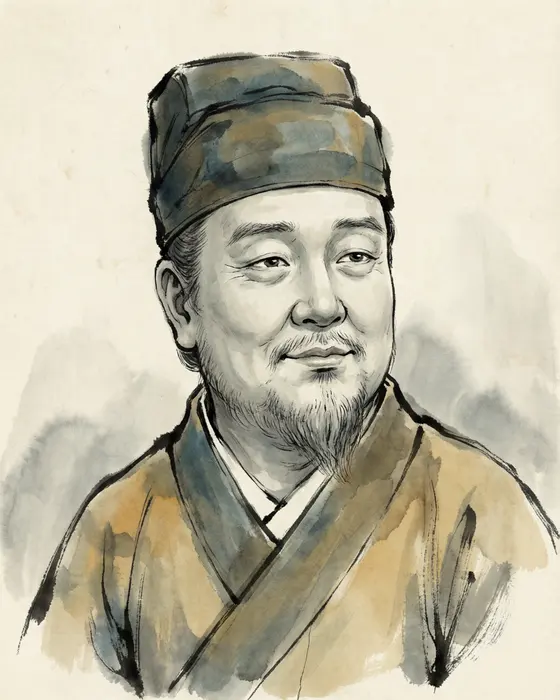
Liu Bei's son, forty-one years emperor of Shu-Han. Surrendered Chengdu in 263 to spare it a sack; at Luoyang told Sima Zhao he was content and did not miss Shu. The record keeps his words and leaves the judgment to the reader.
I am happy here; I do not miss Shu.Liu Shan at Sima Zhao's feast in Luoyang; Han Jin Chunqiu, in Pei Songzhi's commentary to Sanguozhi, Shu shu 3
Appears in
Relations
- Liu Bei son & heir — Inherited his kingdom at seventeen and ruled it forty-one years; it ended at an open gate, forty years after his father's death.
- Zhuge Liang emperor & chancellor — Chen Shou's appraisal says that with a worthy chancellor he was a reasonable ruler.
- Jiang Wei emperor & general — Ordered him at Jiange, unbowed and undefeated, to lay down his arms; later received Jiang Wei's last memorial promising to turn peril into safety.
Myth vs record
The story you may know
A pure imbecile — the proverbial A-Dou who could not be set upright.
What the sources say
He reigned forty-one years, and his surrender was a reasoned decision taken on Qiao Zhou's recorded argument that it would spare Chengdu a sack. At Luoyang his words about being happy may be read as the caution of a captive whose life depended on missing nothing — the sources keep both readings open.