Bamboo Scroll竹簡 Ep. 11 · Thirty-Six Men
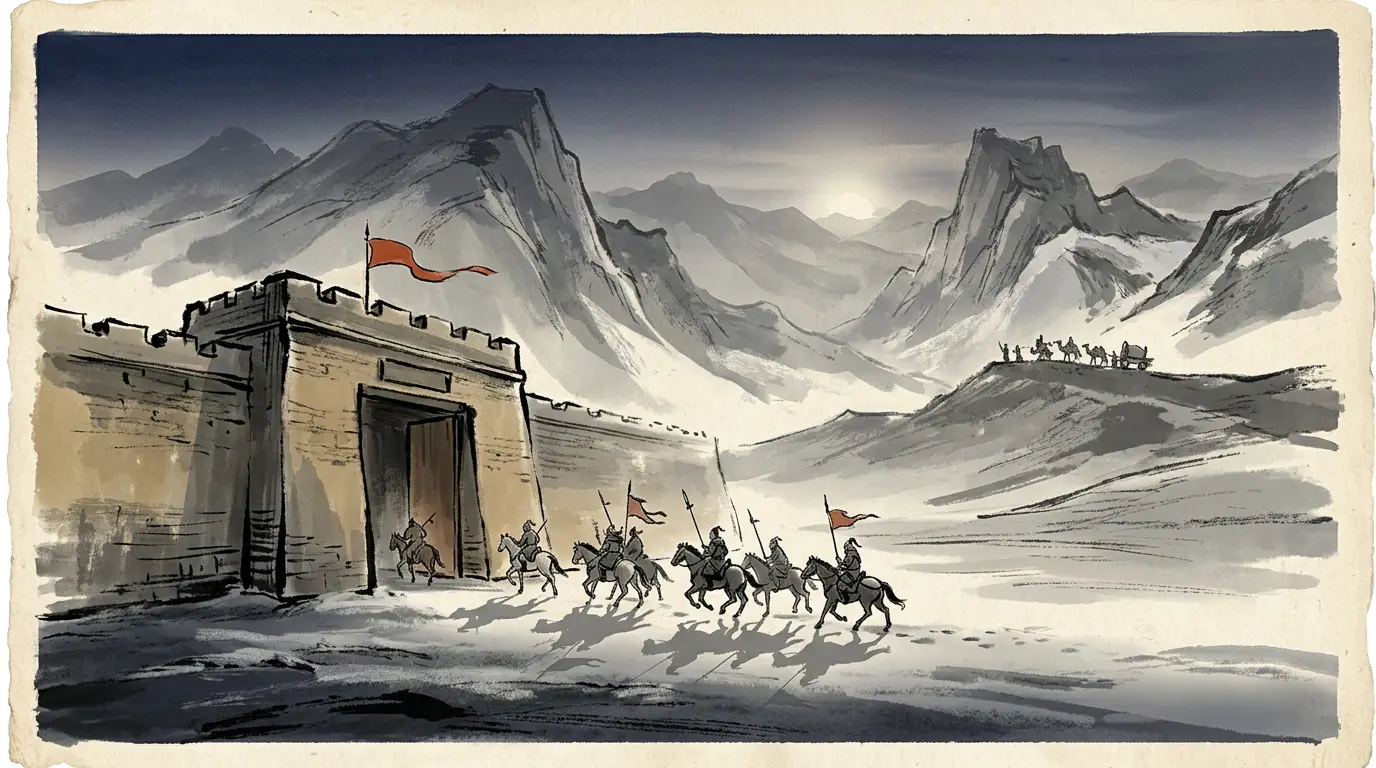
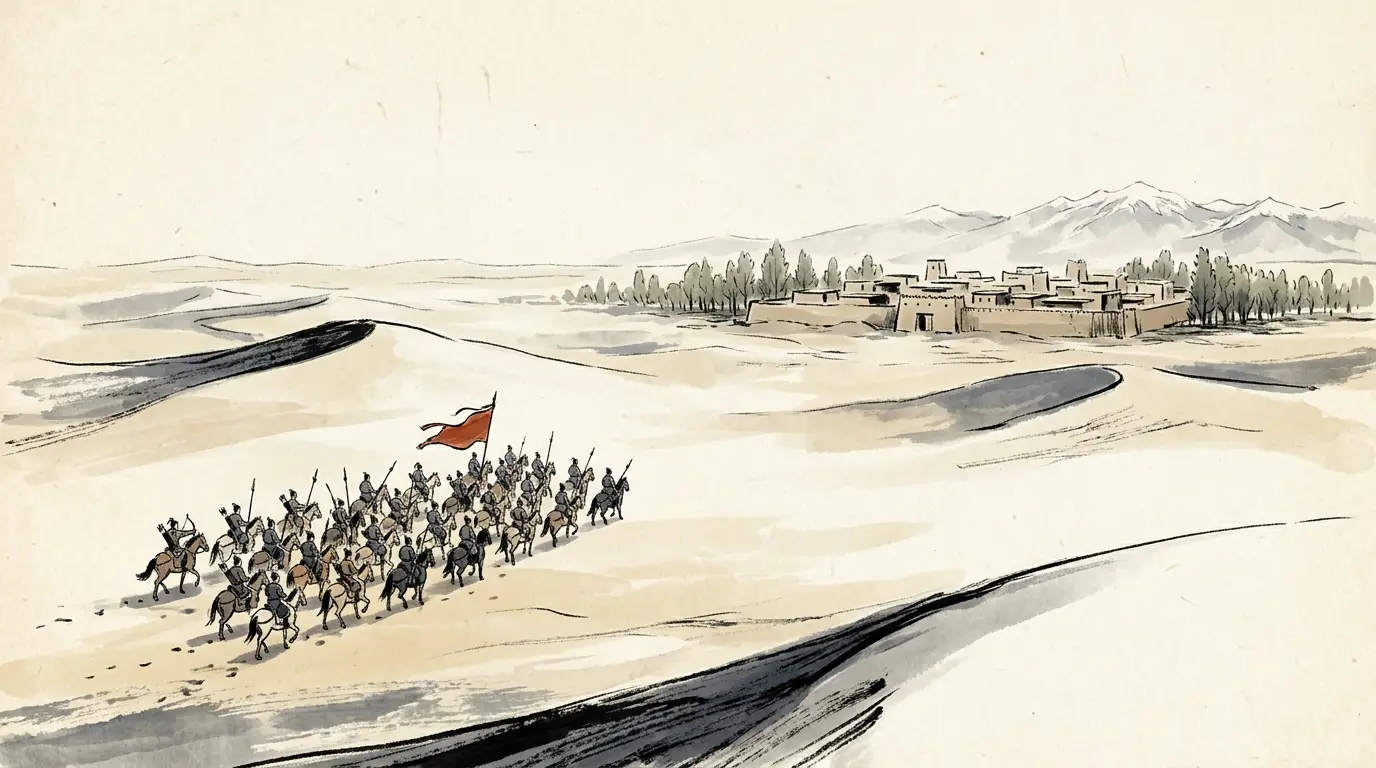
A small troop of Han cavalry with a single vermilion banner riding into the glare of a Tarim Basin oasis town ringed with mud-brick walls, poplars and a distant snow range, 73 CE
Bamboo Scroll · Han · Episode 11

Thirty-Six Men

The Western Regions, 73–102 CE — A clerk of thirty-one took a broom out of a government office and thirty-six men across the desert; one night's fire made an oasis kneel, and for thirty years the road to Rome lay open to a single Han officer and the men who chose to stay.
18 panels~9 min read free to readevery line sourced
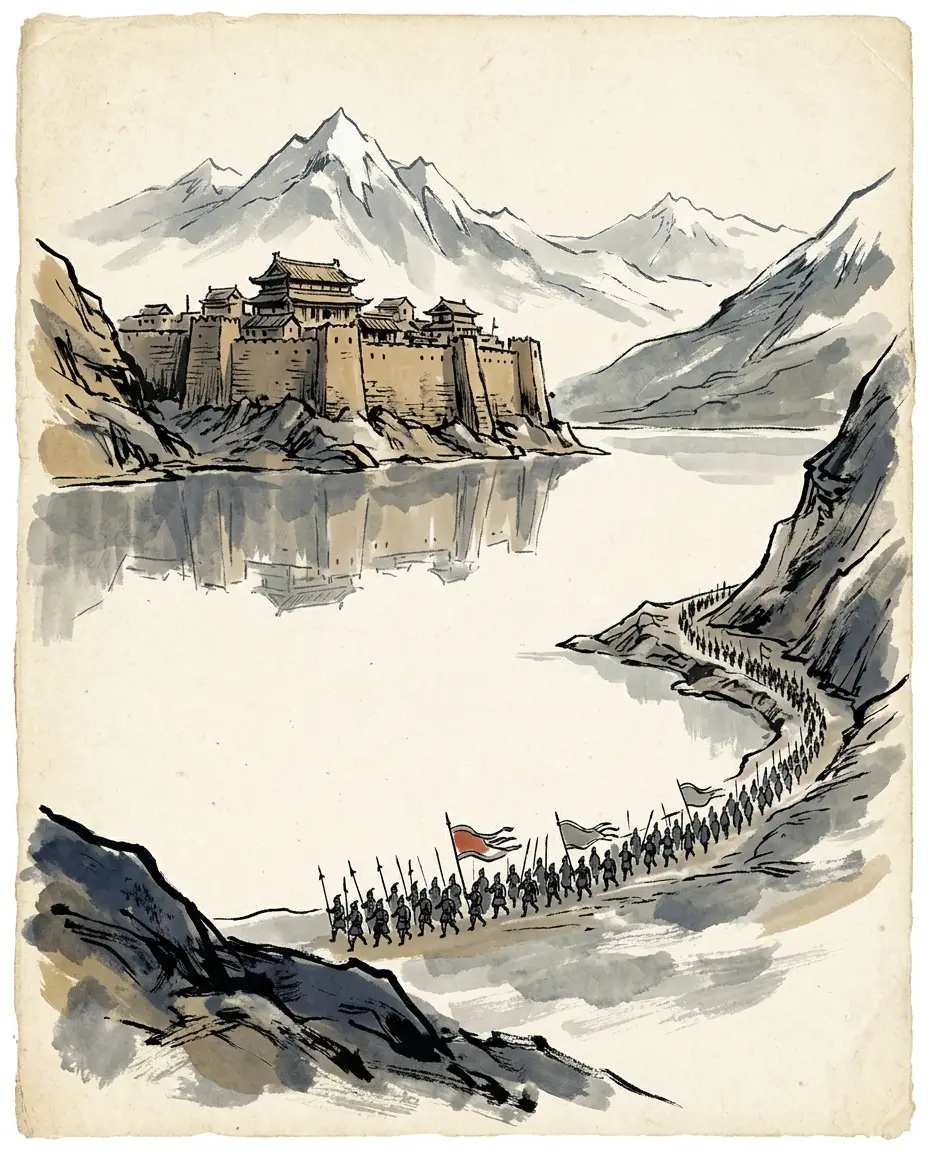
Panel 01: 73 CE. Two days' ride west of the Jade Gate, the Taklamakan — whose name later ages turned into a legend, you go in but don't come out — spread its dunes between the mountain walls. Along its rims sat the oasis cities, half subjects of Han, half of the steppe. One man with thirty-six companions was going to take them back.
73 CE. Two days' ride west of the Jade Gate, the Taklamakan — whose name later ages turned into a legend, you go in but don't come out — spread its dunes between the mountain walls. Along its rims sat the oasis cities, half subjects of Han, half of the steppe. One man with thirty-six companions was going to take them back.
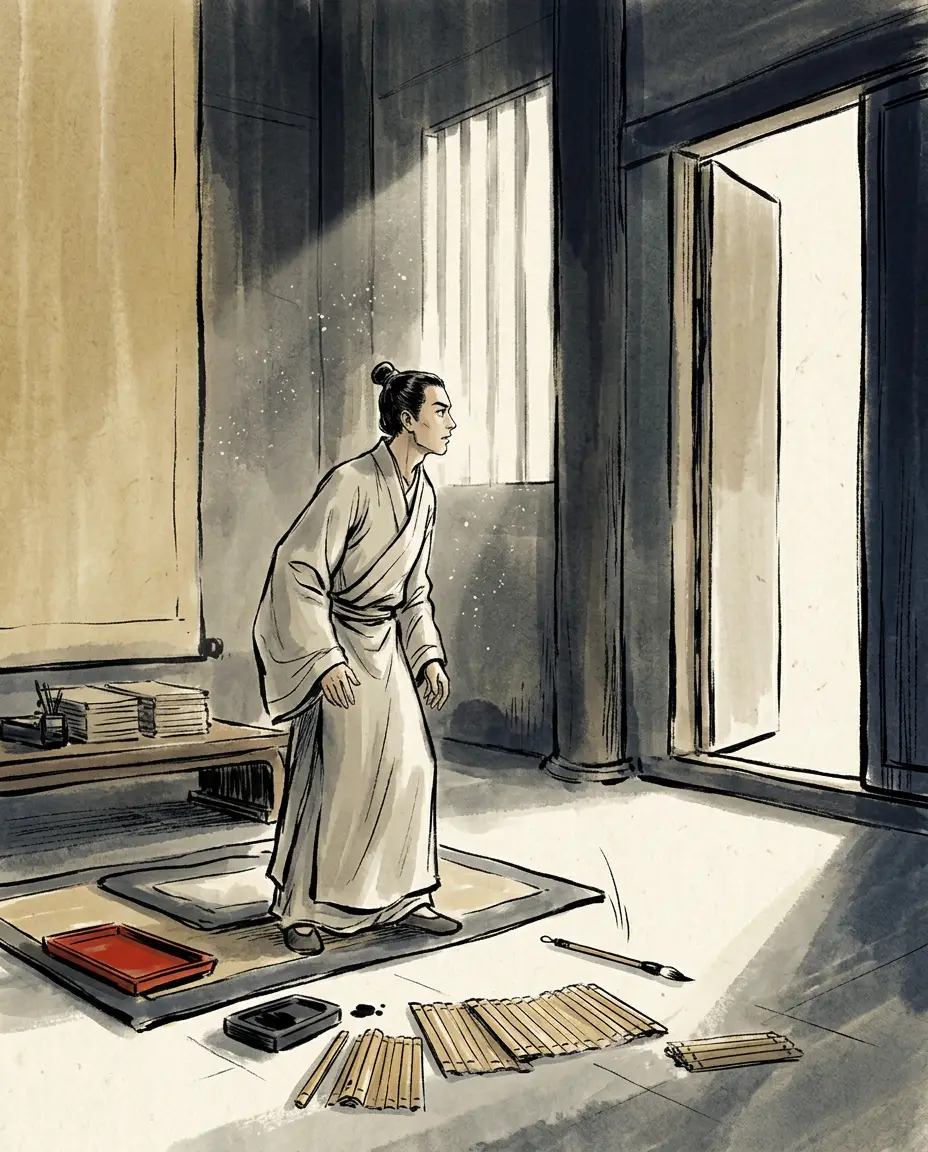
Panel 02: In the capital, Ban Chao was a copy-clerk. He had buried his poverty young, copying documents for pay so his mother would want for nothing — until one day he threw down the brush and said what a man with no other plan should say.
Ban Chao A gentleman should still try to copy the deeds of Fu Jiezi and Zhang Qian, who won their titles by service in foreign lands. How can I go on ageing over a pen and ink-stand?
In the capital, Ban Chao was a copy-clerk. He had buried his poverty young, copying documents for pay so his mother would want for nothing — until one day he threw down the brush and said what a man with no other plan should say.
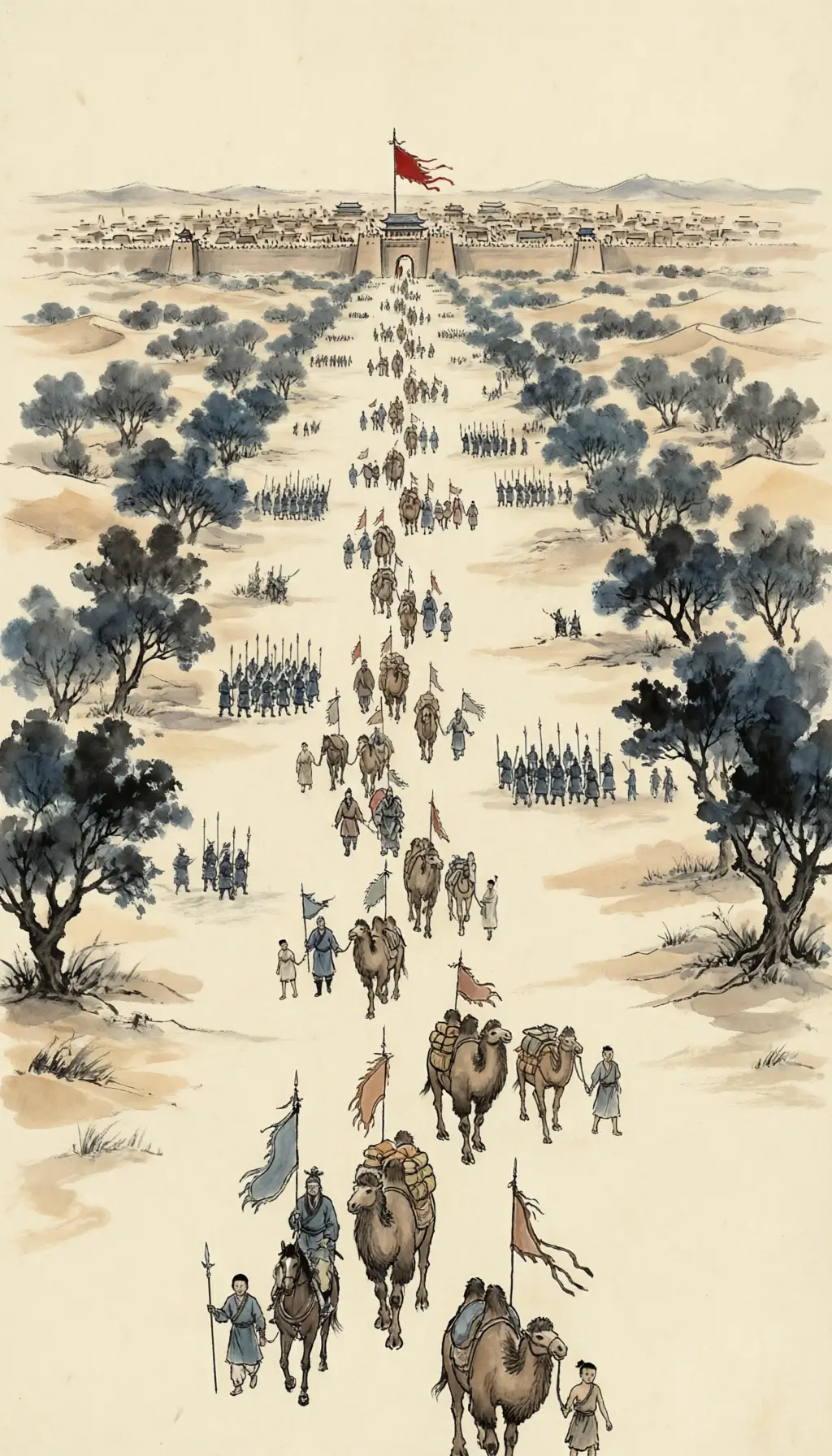
Panel 03: In 73 the General of Chariots and Cavalry sent four columns out of the Jiuquan and Zhangye passes and reached beyond the sands. Ban Chao was given thirty-six men, and an order to carry Han's summons to the oasis states that had taken the Xiongnu's tribute again.
In 73 the General of Chariots and Cavalry sent four columns out of the Jiuquan and Zhangye passes and reached beyond the sands. Ban Chao was given thirty-six men, and an order to carry Han's summons to the oasis states that had taken the Xiongnu's tribute again.
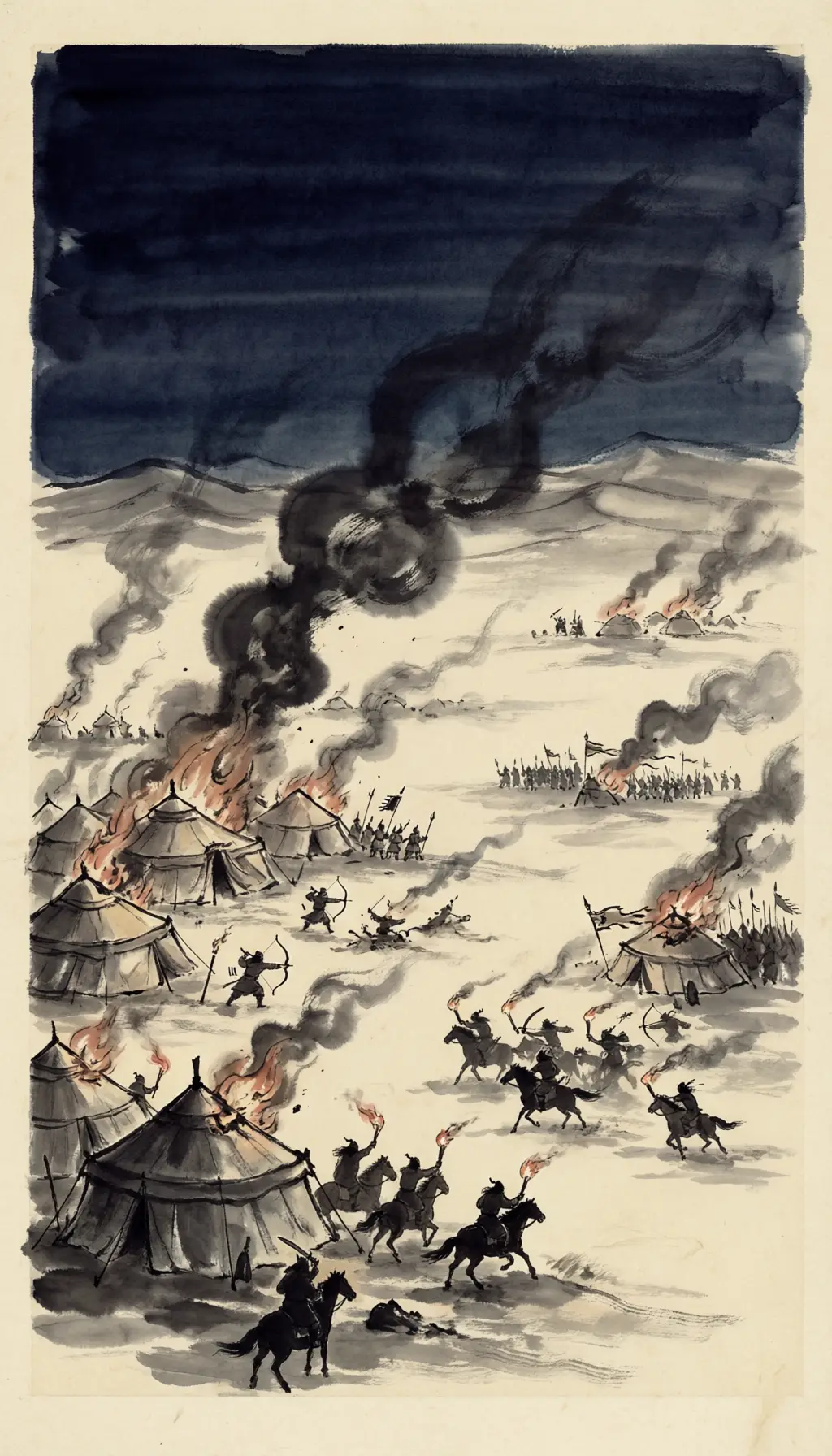
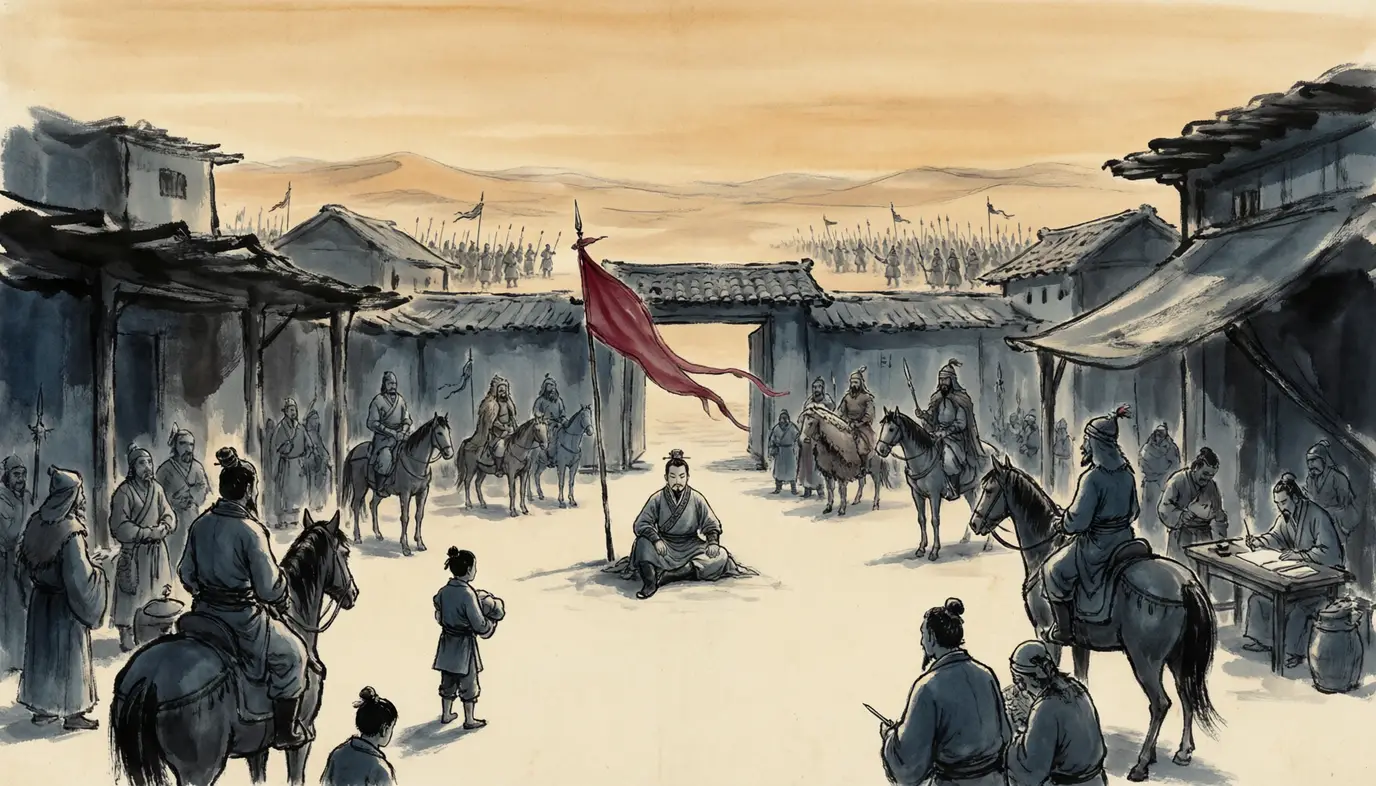
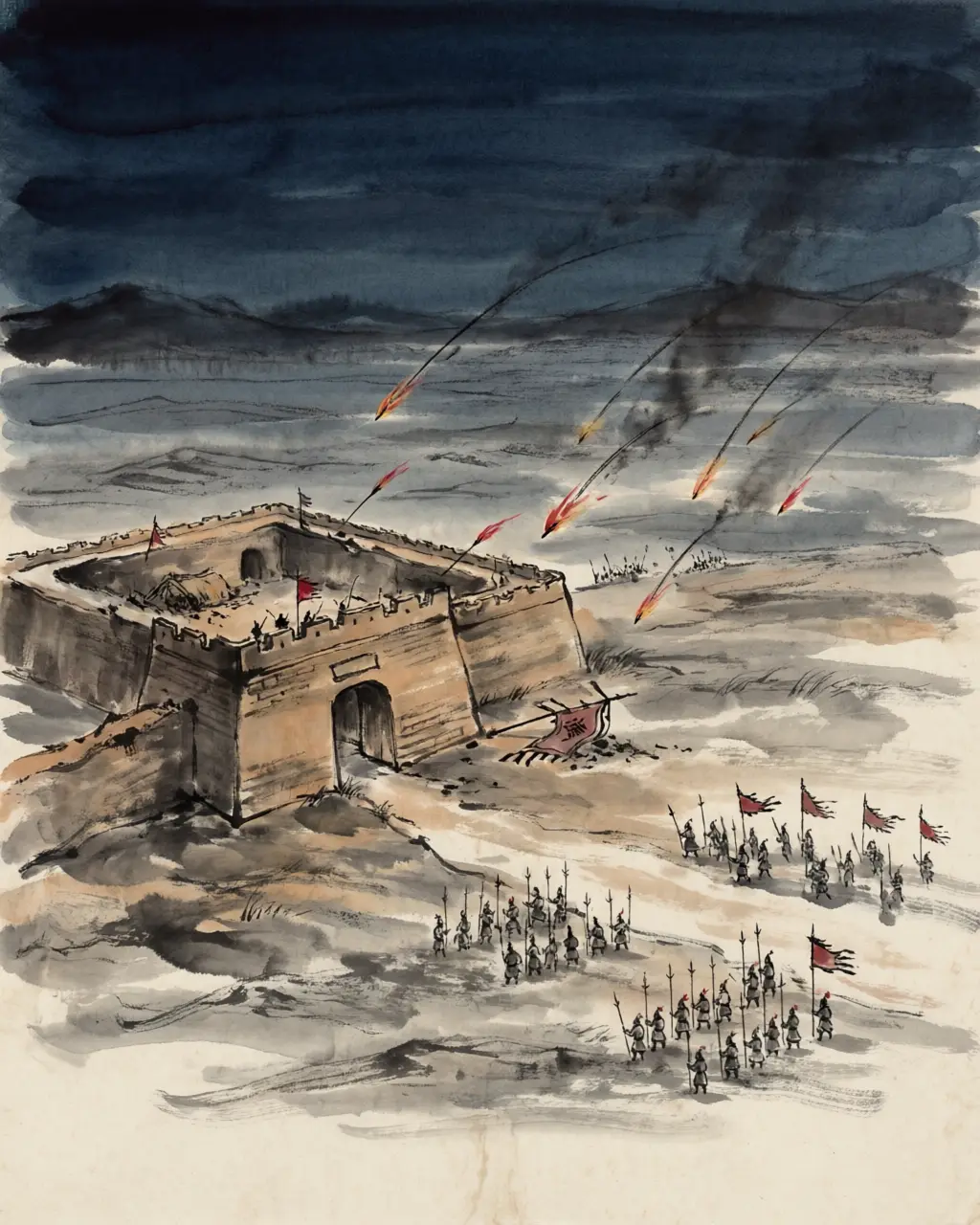
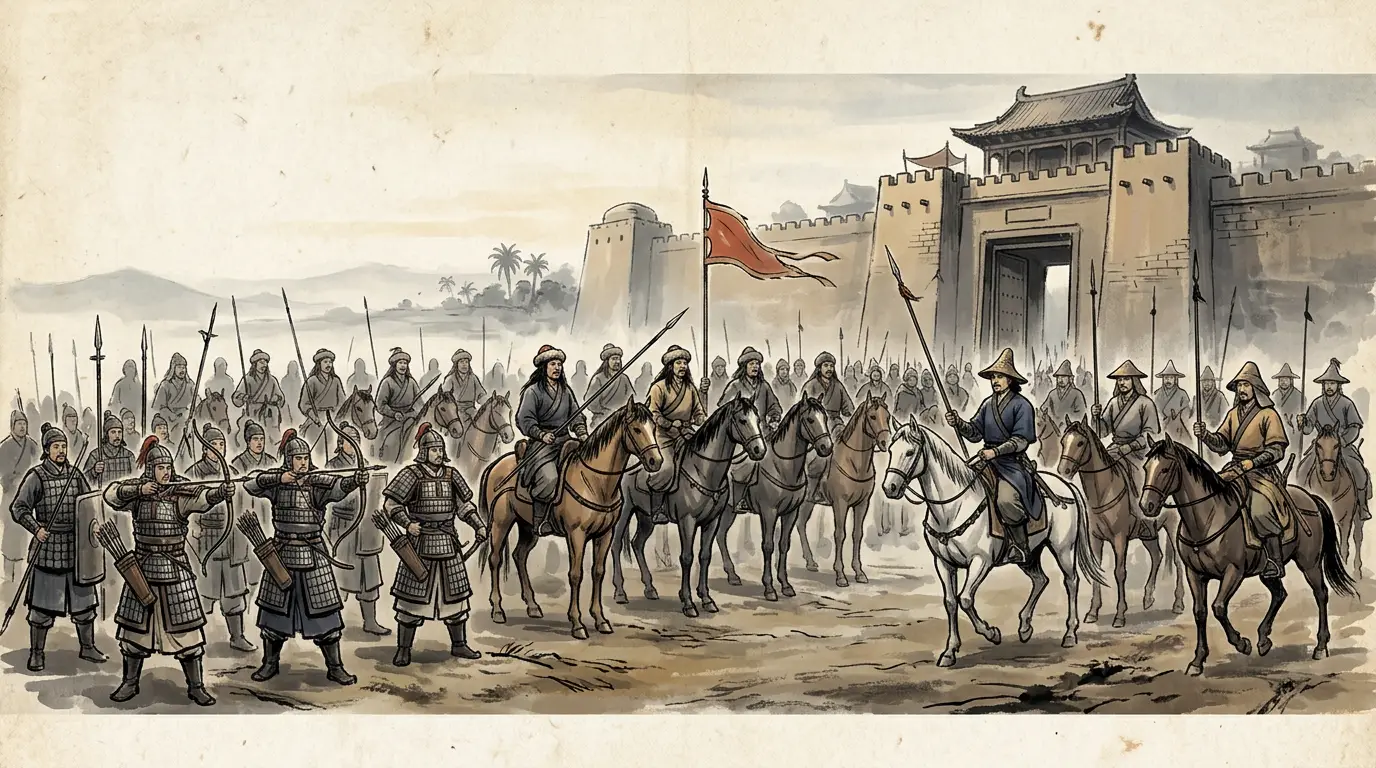
Panel 04: At Shanshan the Xiongnu's envoys came and were entertained. Then word came that thirty-odd more barbarian guests had arrived — and Chao's thirty-six men were drinking in the same camp as the Xiongnu. He knew the king of Shanshan would decide by which guest looked stronger. That night the wind rose, and Chao gave the order.
Ban Chao Not entering the tiger's den, not getting the tiger's cubs. The one plan is fire: tonight they will not know how many we are, and by morning the king of Shanshan will wake to a thing already settled.
At Shanshan the Xiongnu's envoys came and were entertained. Then word came that thirty-odd more barbarian guests had arrived — and Chao's thirty-six men were drinking in the same camp as the Xiongnu. He knew the king of Shanshan would decide by which guest looked stronger. That night the wind rose, and Chao gave the order.
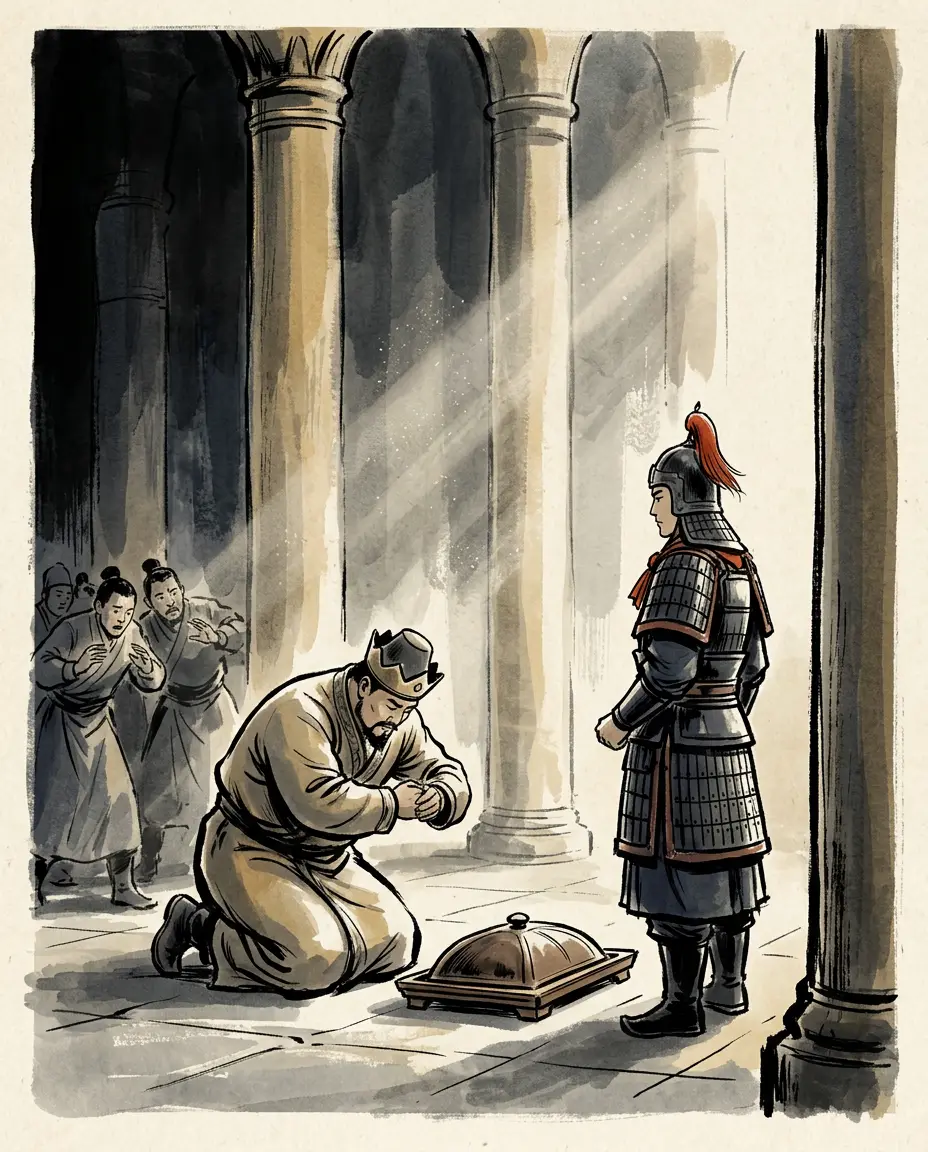
Panel 05: Next morning Ban Chao had the king of Shanshan, Guang, fetched before him and set the Xiongnu envoy's head down between them. The whole land shook with terror, and Guang brought his son in to the Han as a hostage.
Next morning Ban Chao had the king of Shanshan, Guang, fetched before him and set the Xiongnu envoy's head down between them. The whole land shook with terror, and Guang brought his son in to the Han as a hostage.
Panel 06: Chao's rule west was a thin and violent thing: no army to keep, no treasury to draw on, no word obeyed unless it arrived before the next Xiongnu horse. He deposed kings, collected hostages, and paid his troops with what the oases could give.
Chao's rule west was a thin and violent thing: no army to keep, no treasury to draw on, no word obeyed unless it arrived before the next Xiongnu horse. He deposed kings, collected hostages, and paid his troops with what the oases could give.
Panel 07: In 75 the emperor Ming died, and the west came apart. The Xiongnu rode west; the king of Kucha with Kucha's help overran and killed the Protector-General Chen Mu; and the garrison at Shule wanted to send Ban Chao east, out, home.
In 75 the emperor Ming died, and the west came apart. The Xiongnu rode west; the king of Kucha with Kucha's help overran and killed the Protector-General Chen Mu; and the garrison at Shule wanted to send Ban Chao east, out, home.
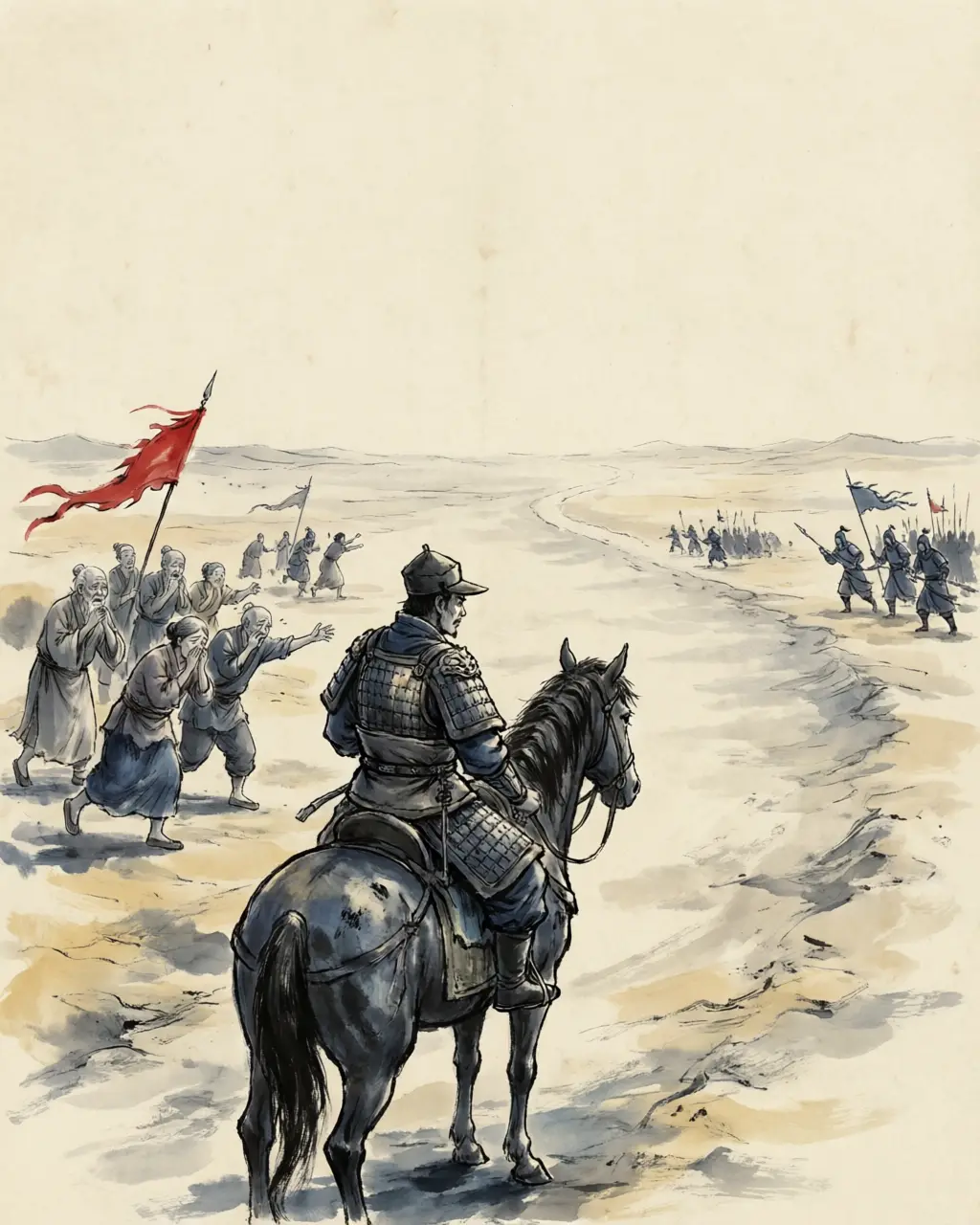
Panel 08: The road out was one day long. The men of Shule came back to him weeping — with the Xiongnu at our backs, where do we go? — and that night Ban Chao turned his horse about and went back into the one province of the west he held with nothing but his own name.
The road out was one day long. The men of Shule came back to him weeping — with the Xiongnu at our backs, where do we go? — and that night Ban Chao turned his horse about and went back into the one province of the west he held with nothing but his own name.
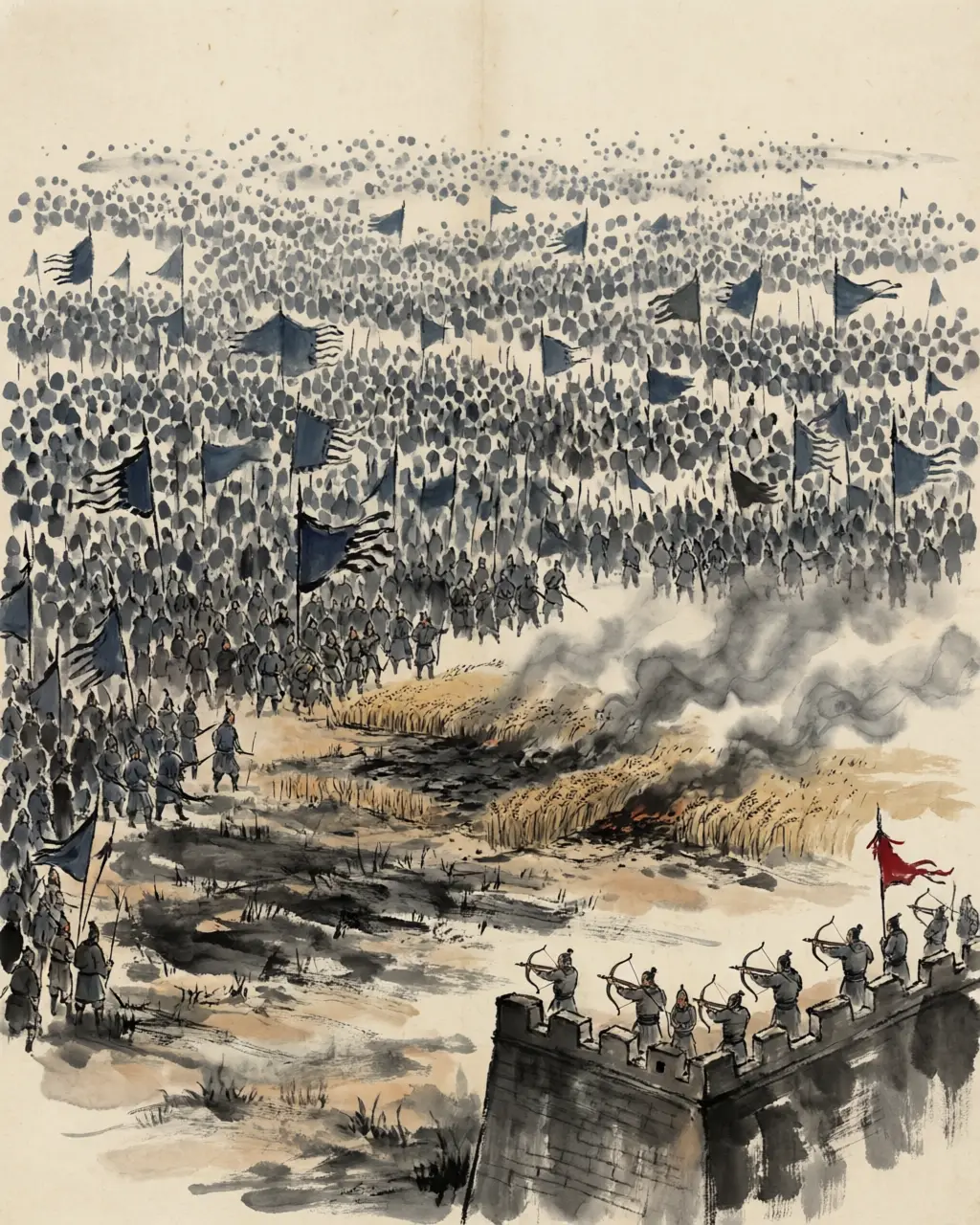
Panel 09: In 90 the Great Yuezhi came up against Kucha with seventy thousand men and a subordinate king of theirs leading them — the same power that reached the sea by way of Bactria. Chao would not give them a battle. He burned the standing grain outside the walls, kept his men shut in and would not answer a challenge, and let their food give out before them.
In 90 the Great Yuezhi came up against Kucha with seventy thousand men and a subordinate king of theirs leading them — the same power that reached the sea by way of Bactria. Chao would not give them a battle. He burned the standing grain outside the walls, kept his men shut in and would not answer a challenge, and let their food give out before them.
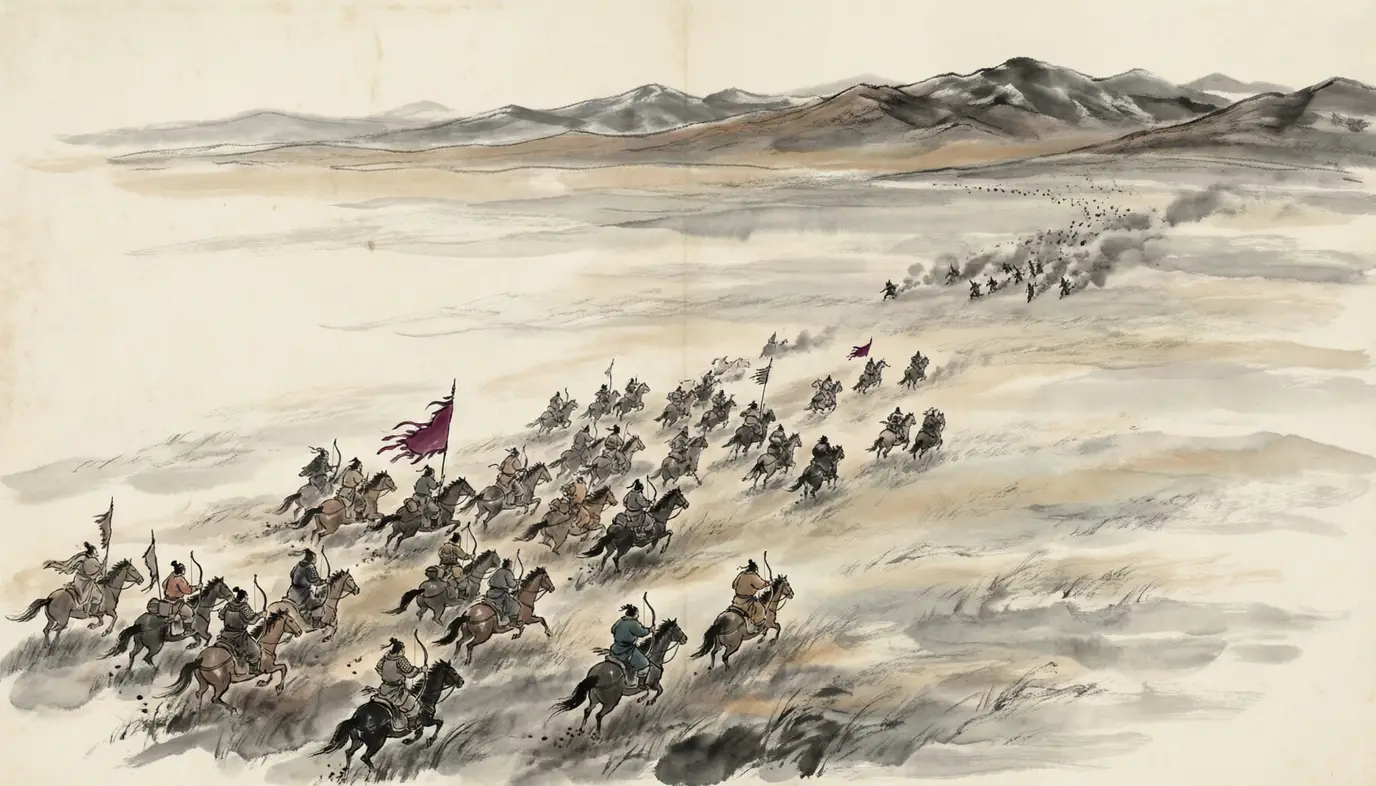
Panel 10: Meanwhile the steppe itself was being settled from the east. In 89 the Grand General Dou Xian rode out of the northern border forts and over the Altai with Han, Southern Xiongnu, Di and Qiang horse five divisions deep, and hunted the Northern Court's chanyu across the great sands.
Meanwhile the steppe itself was being settled from the east. In 89 the Grand General Dou Xian rode out of the northern border forts and over the Altai with Han, Southern Xiongnu, Di and Qiang horse five divisions deep, and hunted the Northern Court's chanyu across the great sands.
Panel 11: In 91 the court made Ban Chao its Protector-General of the Western Regions and gave him a marquisate. Three states thought themselves out of his reach — Yanqi, Weixu and Yuli, who had killed his predecessor — and closed their gates and counted on the distance, the sands, and the season. He came in the spring, with the garrison's men and the oases' levies behind him.
In 91 the court made Ban Chao its Protector-General of the Western Regions and gave him a marquisate. Three states thought themselves out of his reach — Yanqi, Weixu and Yuli, who had killed his predecessor — and closed their gates and counted on the distance, the sands, and the season. He came in the spring, with the garrison's men and the oases' levies behind him.
Panel 12: For the last four years of the work, Chao's army was not a Han army at all. In 94 he marched with the garrison's Han retainers, the levies of Kucha and Shanshan, and borrowed Kangju horse from across the Pamir, and took in one after another the states that had counted on distance and the Xiongnu's name.
For the last four years of the work, Chao's army was not a Han army at all. In 94 he marched with the garrison's Han retainers, the levies of Kucha and Shanshan, and borrowed Kangju horse from across the Pamir, and took in one after another the states that had counted on distance and the Xiongnu's name.
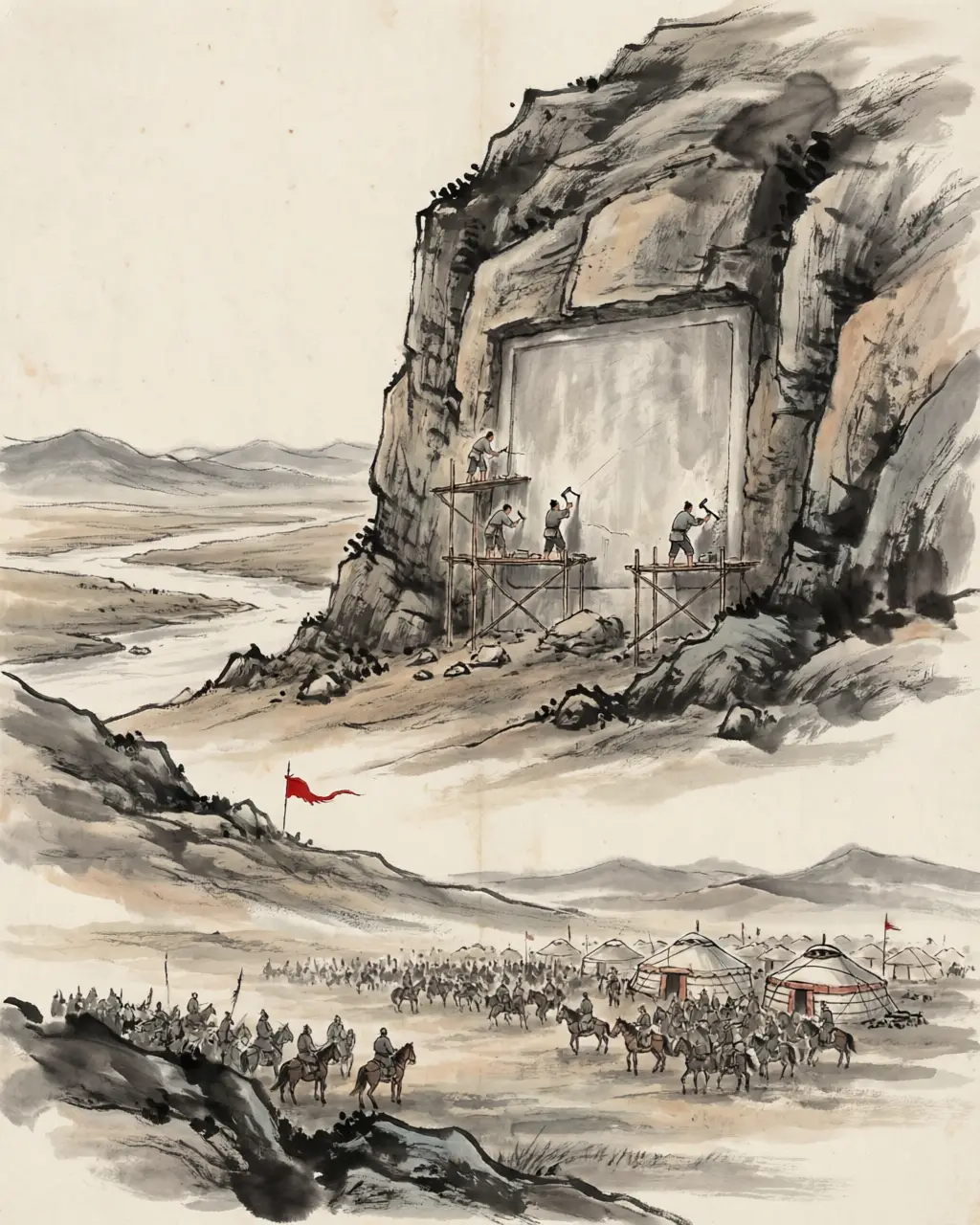
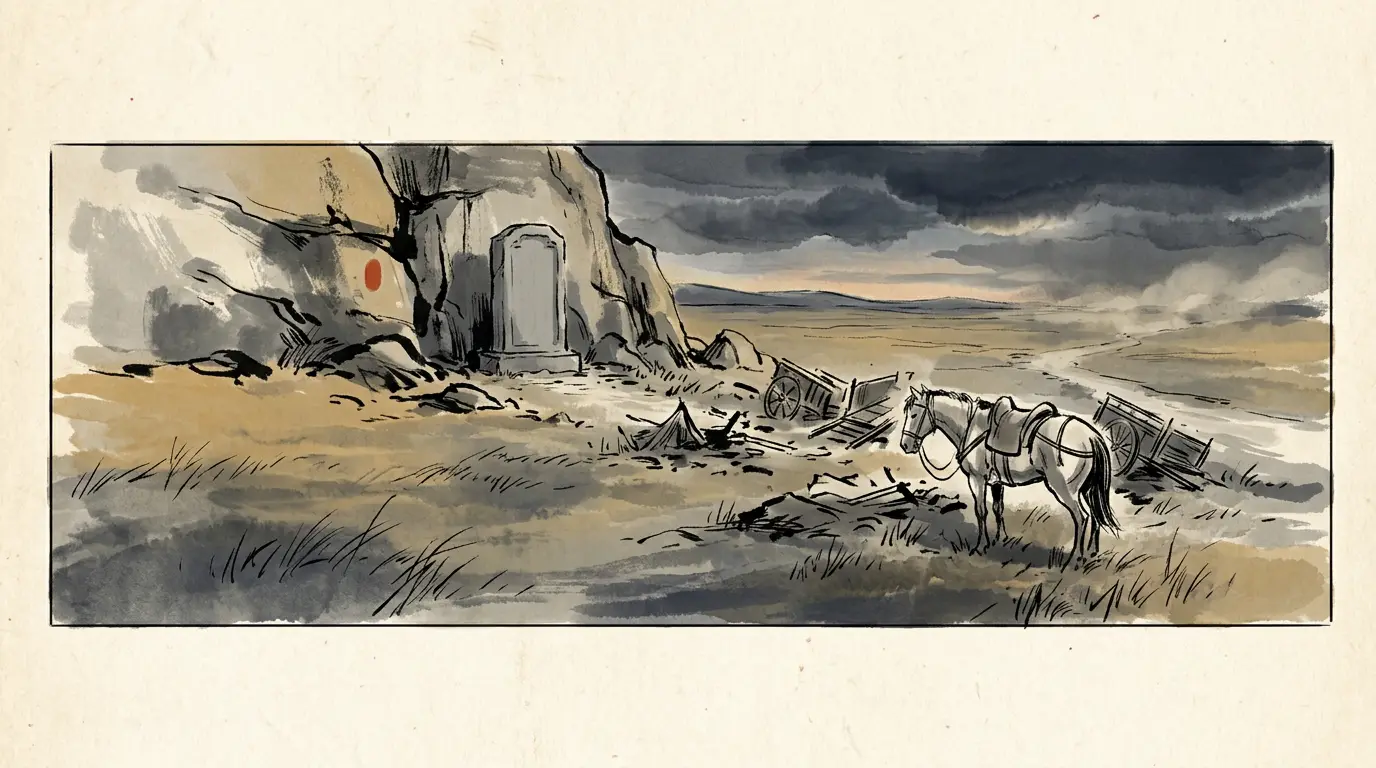
Panel 13: It was Ban Chao's historian, Ban Gu of the Han Annals, who wrote the words at the Yanran Mountain — the campaign's stone, the one thing that outlived every man standing in front of it.
It was Ban Chao's historian, Ban Gu of the Han Annals, who wrote the words at the Yanran Mountain — the campaign's stone, the one thing that outlived every man standing in front of it.
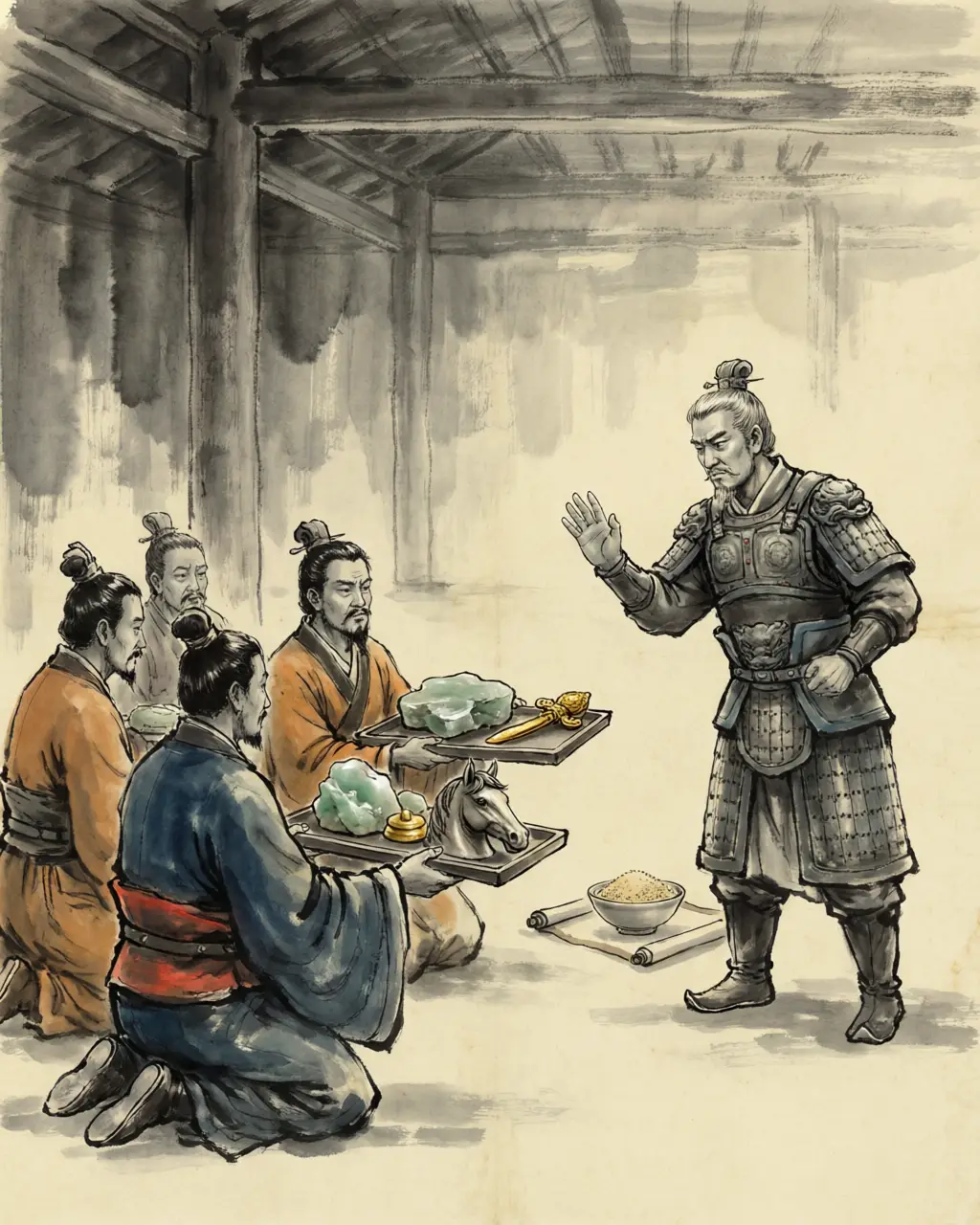
Panel 14: The submitted west sent its treasures east: Khotan's jade, Dayuan's horses that sweat blood, gold of lands Han had never counted. A later saying has Ban Chao scorn it all — he would rather, they say, have the foxes and rabbits of his own country than the gold and jade of foreign lands. His biography does not carry the line.
The submitted west sent its treasures east: Khotan's jade, Dayuan's horses that sweat blood, gold of lands Han had never counted. A later saying has Ban Chao scorn it all — he would rather, they say, have the foxes and rabbits of his own country than the gold and jade of foreign lands. His biography does not carry the line.
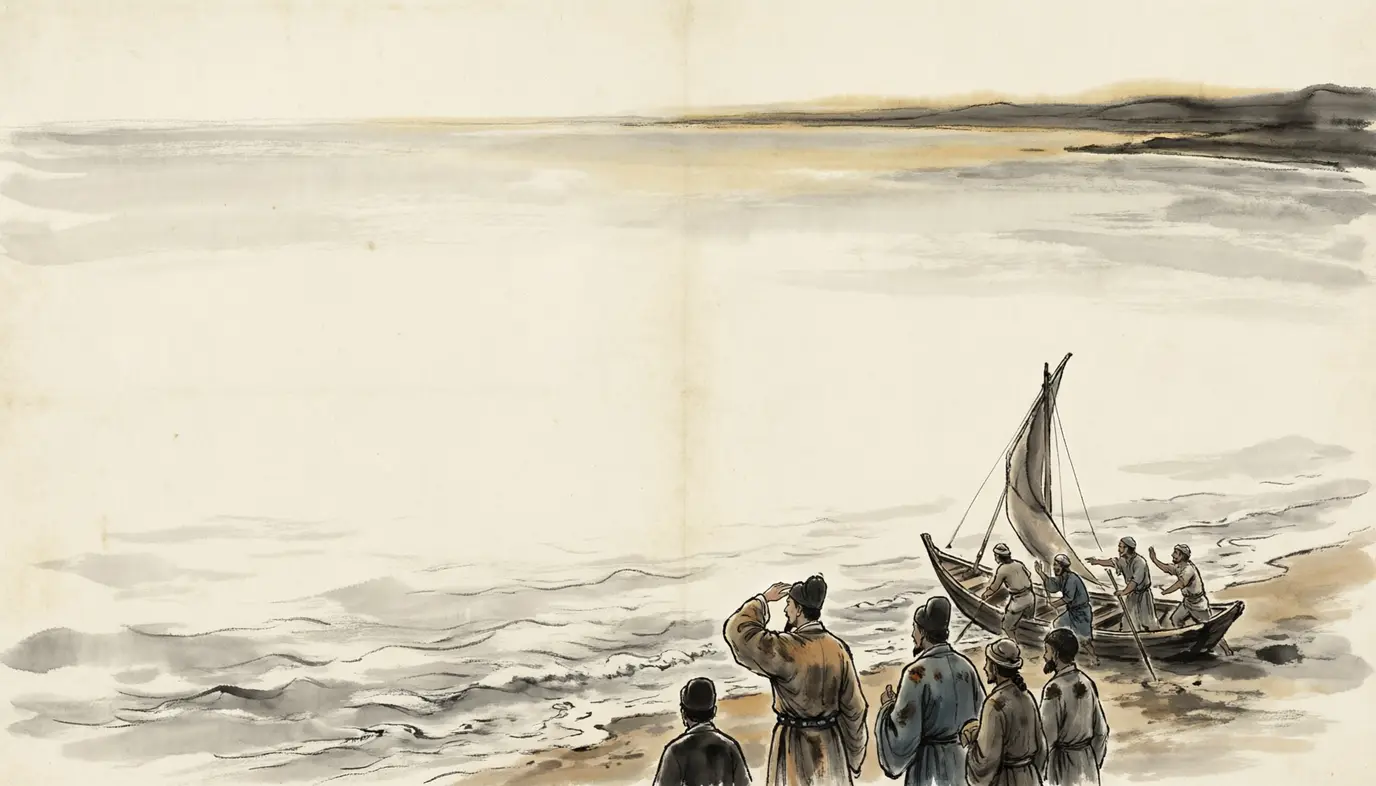
Panel 15: In 97 Ban Chao did the thing no Han man had done: he sent his subordinate Gan Ying west past all the states of the inner lands, to reach Da Qin — the Roman empire — in person. Ying came to Tiaozhi, on the shore of the Western Sea, and had a boat in his eye when the Parthians got there first.
In 97 Ban Chao did the thing no Han man had done: he sent his subordinate Gan Ying west past all the states of the inner lands, to reach Da Qin — the Roman empire — in person. Ying came to Tiaozhi, on the shore of the Western Sea, and had a boat in his eye when the Parthians got there first.
Panel 16: By 97 the road that had been closed for sixty years was open all the way to the sea, and the states of the Western Regions — fifty of them, counting the lanes — paid their tribute in to the garrison at Chao's seat in Kucha. That year Han sent its envoys west; no Chinese embassy ever came nearer to the Mediterranean before the Roman empire fell.
By 97 the road that had been closed for sixty years was open all the way to the sea, and the states of the Western Regions — fifty of them, counting the lanes — paid their tribute in to the garrison at Chao's seat in Kucha. That year Han sent its envoys west; no Chinese embassy ever came nearer to the Mediterranean before the Roman empire fell.
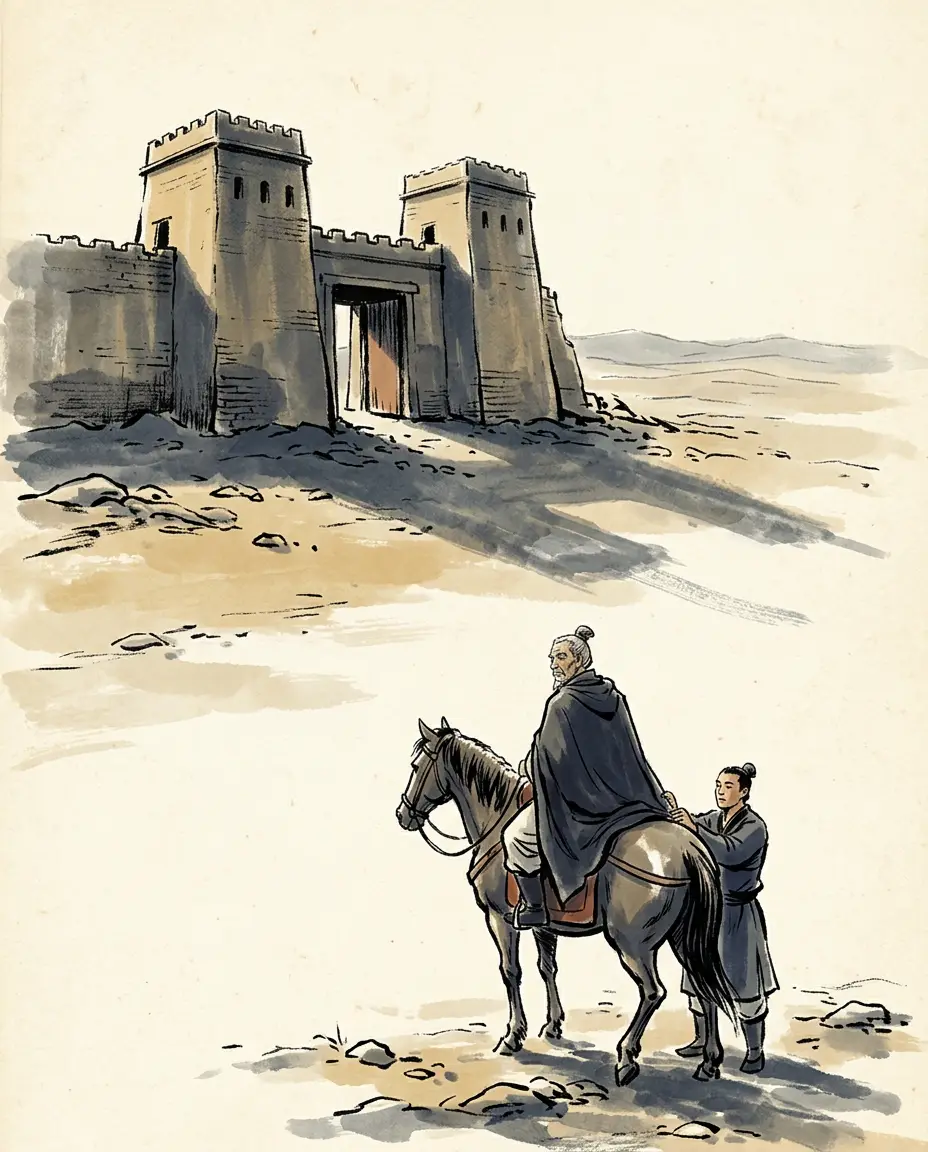
Panel 17: In 102 Ban Chao was seventy-one and his thirty years were out of date: he asked to be sent home. The line of his request became the line every man on the far side of the road knew by heart.
Ban Chao I do not ask to live to see Jiuquan Commandery. I only ask to be carried out alive through the Jade Gate.
In 102 Ban Chao was seventy-one and his thirty years were out of date: he asked to be sent home. The line of his request became the line every man on the far side of the road knew by heart.
Panel 18: Two stones stood at the end of it. The victory stele at the Yanran Mountain kept its words and lost the house that raised it: Dou Xian fell in 92, and Ban Gu, who had written the inscription and served in his staff, died in the Luoyang gaol the same year. And the road west, lost in 107, was picked up again by Ban Chao's son.
Two stones stood at the end of it. The victory stele at the Yanran Mountain kept its words and lost the house that raised it: Dou Xian fell in 92, and Ban Gu, who had written the inscription and served in his staff, died in the Luoyang gaol the same year. And the road west, lost in 107, was picked up again by Ban Chao's son.

In this episode

Five people carried 73 to 102 CE: a clerk with thirty-six men, the general who sent him and later fell, his brother who wrote the record down, the envoy who reached the western sea and turned back, and the son who went out after him.

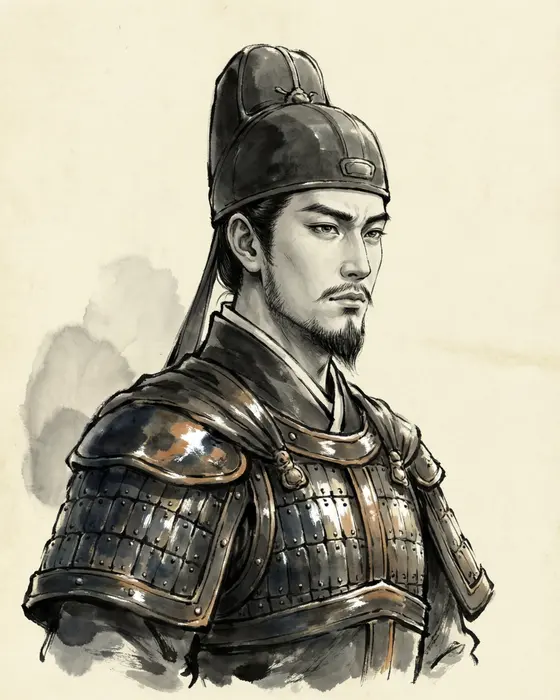
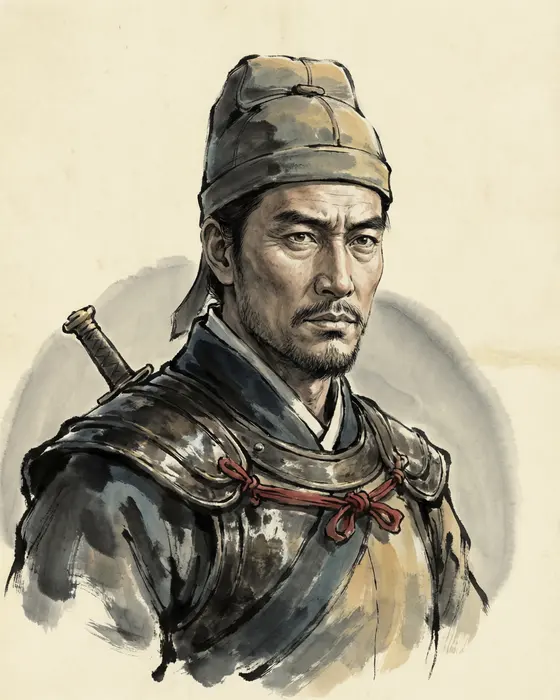
Portrait of Ban Chao
Ban Chao班超
32–102 CE
The clerk who took the road west. Thirty-six men at Shanshan, thirty years in the Western Regions, and the title Marquis Who Settles the Far.
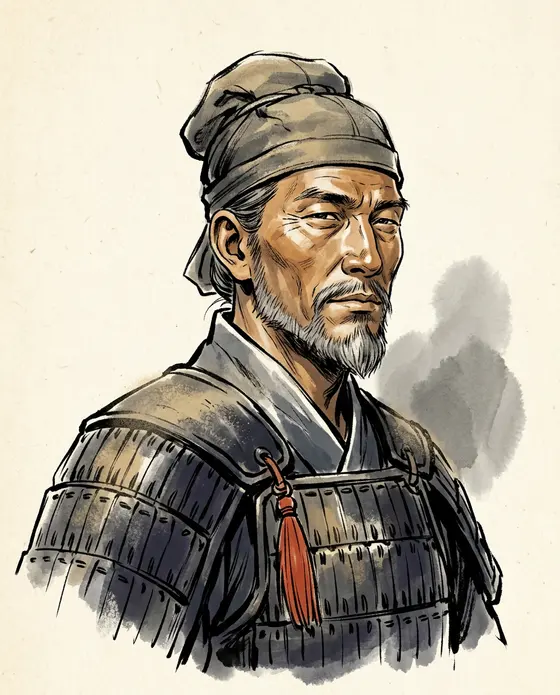
Portrait of Dou Xian
Dou Xian竇憲
d. 92 CE
Grand general of the imperial in-laws. Rode five thousand li past the Altai to the Yanran Mountain and cut his victory in stone — and fell three years later, with the man who wrote that inscription, Ban Gu, dead in gaol.
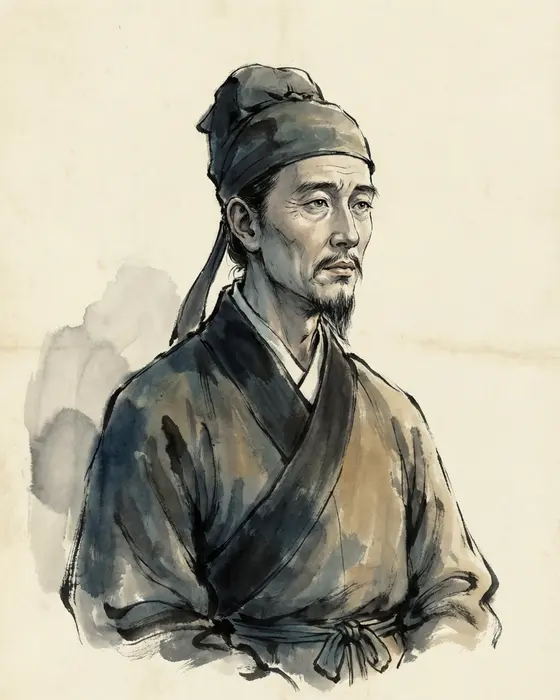
Portrait of Ban Gu
Ban Gu班固
d. 92 CE
The historian of Han who traded his pen for a sword-stroke at the Yanran Mountain; author of the stele's inscription, dead in the Luoyang gaol the year after it was raised.
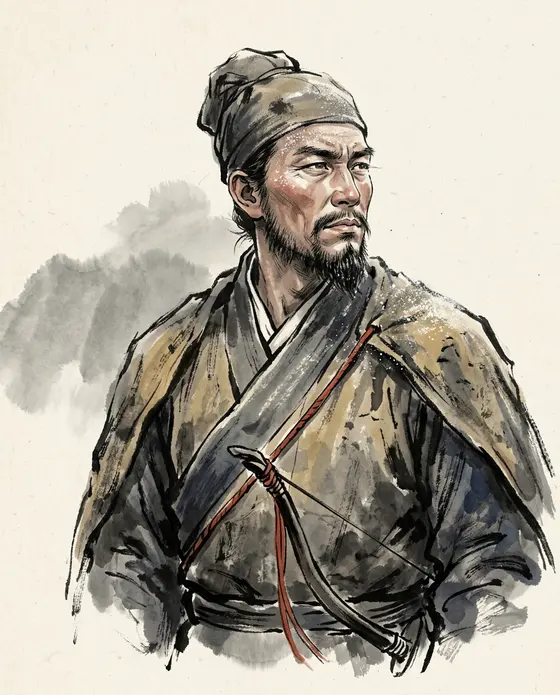
Portrait of Gan Ying
Gan Ying甘英
fl. 97 CE
Ban Chao's envoy, the farthest-reaching messenger of Han: he came to the Western Sea and looked at Rome — and was talked out of the crossing.
Portrait of Ban Yong
Ban Yong班勇
fl. 102–127 CE
Ban Chao's son, who inherited the western business, argued the court back into the Western Regions and recovered it with a staff of five hundred.

Myth Check

The Ming romances of the Han dynasties, the stage plays drawn from them and the serials drawn from those are entertainment — and not a source. Where their famous scenes depart from the histories, we leave them out of the story and put them here.

The story you may know

Ban Chao's name for the desert, Taklamakan, has meant “go in and don't come out” since antiquity.

What the sources say

The etymology is a modern folk one, and the desert's name is not Chinese anyway; what the sources give is the “great sands” and a chain of city-states. The terror is not in the name: it is in the record of what it took to cross on.

Hou Han shu, Memoir on the Western Regions; on the folk etymology, nothing earlier than modern travel writing
The story you may know

Ban Chao declared that he would rather love one fox or rabbit of his own court than the gold and jade of foreign lands.

What the sources say

A later apophthegm put in his mouth: the polished maxim appears in the telling, not in Ban Chao's Hou Han shu biography. What the record carries is his practice — fifty-odd states held with silk, hostages and titles, treasures sent in by submissive states, and no plunder attributed to him; the sentiment is Ban Chao's, the sentence is not.

Hou Han shu, juan 47, Hereditary Biographies of Ban Chao and Ban Liang; the maxim's wording is absent from the text
The story you may know

Gan Ying reached the Roman empire and stood in a provincial city of Syria.

What the sources say

The record says he came to the shore of the Western Sea and turned back without crossing. Most modern readings place the shore on the Persian Gulf, with the Parthians' scare-story about the sailing time deliberately told to keep the silk trade to themselves; taking him to Antioch asks the text to say more than it does.

Hou Han shu, Memoir on the Western Regions
The story you may know

Ban Chao won the west with armies: his thirty-six men grew into a garrison force, and the empire held the Silk Road on Chinese arms.

What the sources say

The arithmetic is what the story forgets. The western dominion ran on staffs of dozens and, at need, borrowed cavalry: at the end his army was Kucha's and Shanshan's levies with Kangju horse on loan. No pitched battle won by an army sent from the east decided any of it — the west was held by diplomacy with a knife behind it, by a garrison the size of a village.

Hou Han shu, juan 47, Hereditary Biographies of Ban Chao and Ban Liang
The story you may know

The Taklamakan road was a peaceful caravan route with an empire at its far end.

What the sources say

What the records give is a corridor that had to be won again every generation, with Han itself abandoning it for thirty years (76–94) and finally for good in 107; the thirty-six states counted by Han were thirty-six because they kept splitting, merging, and changing masters — a taxonomic running count, not a settled map.

Hou Han shu, Memoir on the Western Regions; juan 47, Hereditary Biographies of Ban Chao and Ban Liang

Sources

Every caption and quotation in this episode traces to one of these. Where scholars disagree, the panel says so.

Next

One officer held the road for thirty years; then the court that inherited it looked inward, at the families whose reputation had become a political danger: Episode 12 · The Deep Roots (The Partisan Prohibitions, 166–184 CE). And the court that lost the road turned on its own notables. Or back to the Han line, or meet the cast.